Contentoo vs AirOps: who should own your content workflow?


TL;DR
Contentoo vs AirOps comes down to who should build, run and maintain your content workflow, and how much of that work you want to buy as a service. AirOps is a content engineering and AI search platform. Your team can operate it alone, with help from AirOps’ solution architects and training, or through a partner that builds and runs workflows for you. Contentoo runs a managed content workflow around your business needs, bringing AI and human expertise together while your team provides context, strategic direction and final approval. Choose AirOps if you want to own an AI content engine, whether you operate it yourself or bring in help. Choose Contentoo if you want content production, including expert input and localisation, managed as a single service.
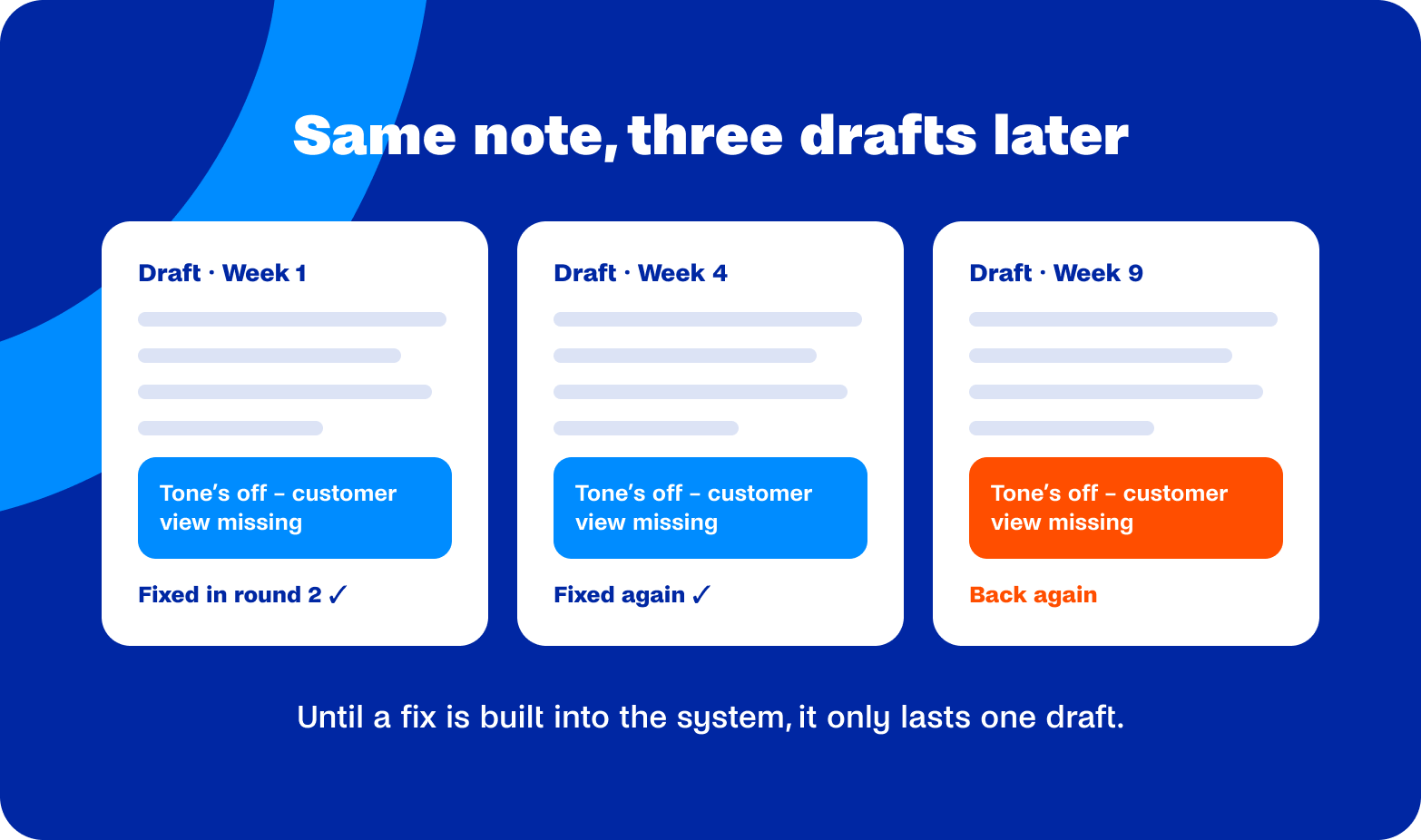
This might sound familiar. Imagine you’re reviewing a piece of AI-generated content and spot a problem you’ve seen before. Maybe the tone is slightly off, the customer perspective has disappeared, or the draft is covering all the expected points without really saying anything useful. You leave the feedback, the next version is better, and the piece gets approved.
A few weeks later, you see the same issue in another draft.
There’s nothing unusual about this. AI can respond to feedback remarkably well in the moment, but the harder part is making sure that feedback carries forward into the next piece, and the one after that. Someone needs to turn the lesson into a persistent part of the system: a Brand Kit rule, a guardrail, a workflow step, or another instruction the engine can consistently apply.
That’s one of the less obvious consequences of making content generation cheaper and easier. The scarce input isn’t another draft; it’s the judgement that decides what gets made, what gets cut, what needs another pass, and what’s good enough to publish… then makes those decisions repeatable across the workflow.
Both AirOps and Contentoo address that challenge, but they put the responsibility in different places.
The sections below compare what each model actually asks of your team, from briefing and content creation to review, localisation, optimisation, and publishing.
Contentoo vs AirOps at a glance
Both companies sell to mid-market and enterprise teams, and both combine AI with human judgement. The key difference is not feature count, but the operating model behind the content workflow.
| Contentoo | AirOps, self-operated | AirOps, service-supported | |
|---|---|---|---|
| What you’re buying | Managed content workflow | Platform licence | Platform licence plus AirOps enablement, or a separate partner engagement |
| Who builds and maintains the workflow | Contentoo | Your team | Shared: AirOps advises and helps build; a partner may build and run it. Scope varies |
| Who executes each step | Contentoo’s managed team and AI agents | Your team and configured AI workflows | Configured workflows, operated by your team or a partner |
| Where quality control sits | Within the managed workflow | Your review process | Depends on the agreement: establish who reviews, and against what standard |
| Your team day to day | Provide context, direction and approval | Build, operate, review and improve workflows | Provide context and approval; oversee the partner or apply AirOps’ guidance |
| Company and market focus | Netherlands-based, built for international content production | US-based, built for AI-powered content and search growth | As self-operated; partner location and markets vary |
| Localisation approach | Native expertise built into production where required | Market workflows and native reviewers need to be configured and sourced | Check whether the partner supplies native expertise per market or only builds the workflow |
| AI search visibility | Incorporated where relevant | Core part of the platform | Core; Offsite extends it to third-party placements |
| Pricing model | Managed engagement | Task-based plans | Task-based plans, plus partner or service fees where applicable |
| Best fit | Teams that want complex production managed end to end | Teams with capacity to operate an AI content engine | Teams that want to own an AI engine but need help building or running it |
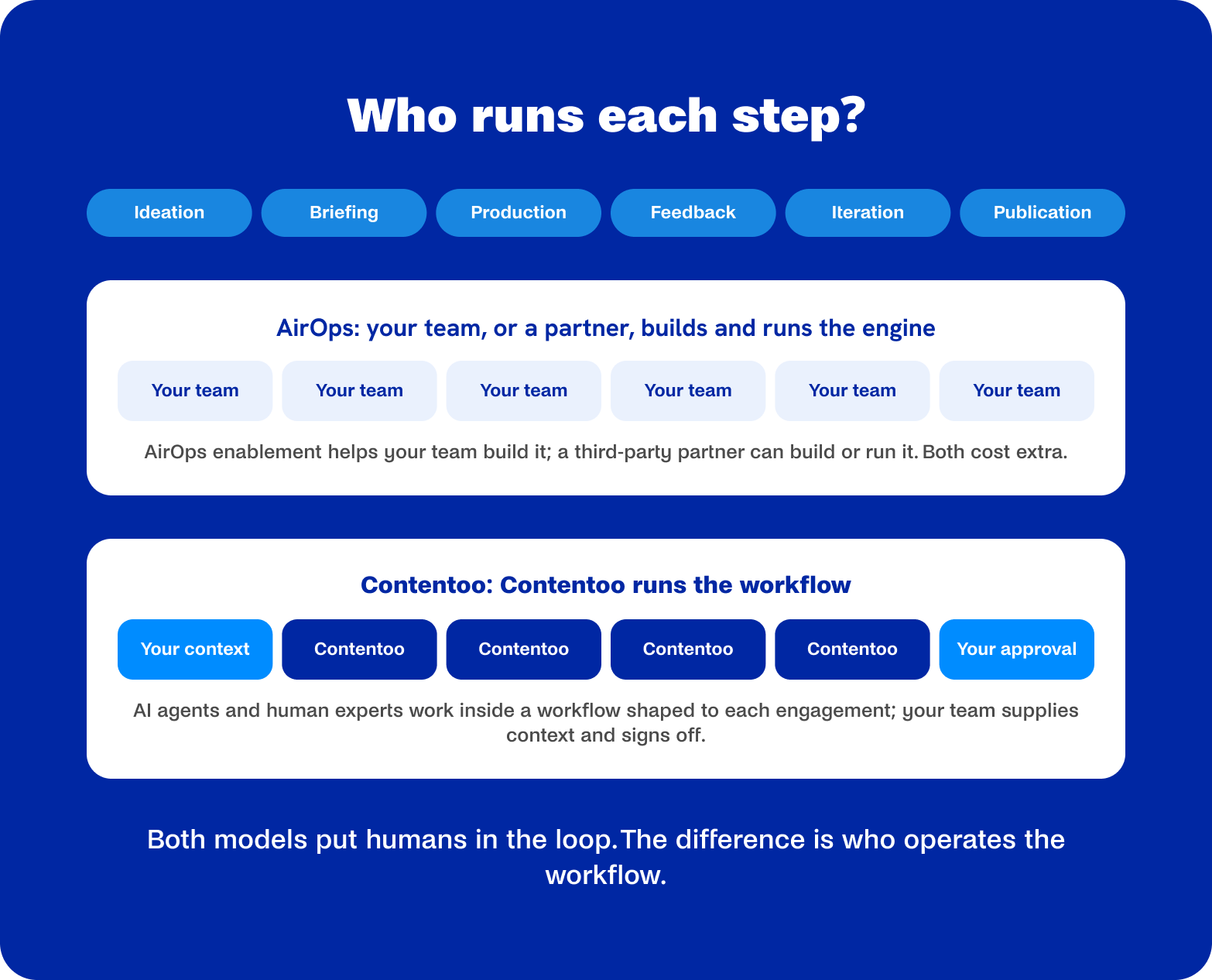
The distinction is easiest to understand by following the work behind a piece of content. Automating content production doesn’t remove the decisions about context, quality, review and localisation; it moves them upstream into workflow design and maintenance. Both models can produce content at scale. What differs is who is responsible for making the workflow work, and for keeping it working.
What is AirOps built to do?
AirOps is built for teams that want to connect AI search visibility data with content production and optimisation. Its proposition goes beyond generating articles: it helps teams identify where their brand is appearing (or missing) in AI answers, find opportunities in existing content, and turn those insights into actions at scale.
AirOps tracks how a brand appears in AI search results across answer engines, including ChatGPT, Perplexity, Gemini, and Google AI Overviews, giving teams a way to connect answer engine optimisation with content production. That makes it relevant to teams thinking beyond traditional search and trying to understand where their brand appears in AI answers as Google AI Mode and other AI search experiences become part of the buyer journey.
That makes AirOps particularly relevant to content and SEO teams that already have a production function and want to make it more systematic. The platform brings AI visibility tracking, content research, workflow automation, human review, and publishing into a connected system, rather than requiring teams to stitch together separate tools for each part of the process.
The important distinction is that AirOps gives your team the machinery to run the content operation. Your team still decides how that machinery should work, what context it needs, and where human judgement belongs.
Content engineering, Playbooks, and Quill
AirOps’ building blocks map fairly neatly to the work involved in running an AI content engine.
Brand Kits and Knowledge Bases provide the context. Brand Kits define brand voice, tone, rules, and guidelines, while Knowledge Bases can bring proprietary information and other data sources into workflows. Integrations then connect that context with CMS platforms, SEO tools, project management tools, and other parts of the existing content stack.
AirOps also connects with the systems teams already use to manage and publish content. Its native CMS integrations include WordPress, Webflow, Contentful, Sanity, Contentstack, Ghost, and Strapi, while its wider integrations cover SEO, project management, and other content operations. That means teams can move from SEO research and AI search insights to content production and, where the workflow allows, publish directly to their CMS rather than relying on manual hand-offs.
Workflows and Playbooks provide the process. Teams can combine data sources, AI models, human review, and publishing into repeatable workflows. Playbooks package a sequence of instructions and outputs into a reusable process that can be refined around a particular production task.
Quill provides the agent layer. AirOps describes Quill as its AI agent for driving AI search growth. It can surface visibility gaps and run Playbooks to act on them, including content refreshes, creation, gap filling, and other optimisation work. A press release published on Business Wire states that Quill learns from user edits and overrides, helping it align more closely with a brand’s requirements over time. That’s an AirOps product claim, rather than a guarantee that every workflow will improve automatically.
The result is a connected system that lets teams bring together search signals, workflow automation, AI generation, human review, and publishing without necessarily moving between several different tools.
That connected model is one of AirOps’ strongest propositions. The question is what happens once the team has built the system.
Where AirOps is strongest
AirOps is particularly well suited to repeatable optimisation programmes where there’s a large existing content library and plenty of data to act on.
Its AI search capabilities can identify the prompts and queries where a brand is visible, the sources being cited by AI engines, and gaps where existing content could do more. However, there's a limitation worth understanding when evaluating that visibility layer. AirOps’ entry-level Solo plan provides ChatGPT insights only, while broader answer-engine coverage starts with Pro. That matters if your definition of AI visibility includes Google AI Overviews, Google AI Mode, Perplexity, Gemini, and other AI search results rather than visibility in a single model.
The platform can then connect these insights to actions such as content refreshes and new content creation. AirOps says its refresh programmes can bring together current AI citations, Google Search Console performance, Google Analytics engagement data, and other signals to identify where existing content needs attention, then generate a targeted update, route it through human review, and publish it to a CMS.
That closed loop is important for teams managing hundreds or thousands of existing pages. Instead of treating content refresh as a periodic manual audit, they can monitor visibility data and SEO performance, spot opportunities, and build a repeatable programme to act on them.
The same applies to content production from structured or proprietary data. AirOps can connect data sources, knowledge bases, AI models, and publishing steps into workflows, making it useful for programmatic content creation and other high-volume use cases where the inputs and rules are reasonably well defined.
It’s also strong where a team wants to keep humans in control without making every step manual. Workflows can include human review and approval before content is published, so automation doesn’t have to mean removing editorial oversight.
The trade-off is that the insight and the execution sit in the same system. If AirOps identifies a stale page, a citation gap, or another optimisation opportunity, acting on that opportunity generally means running the relevant workflow, Playbook, or Quill-powered process. Those actions consume AirOps tasks, and their effectiveness depends on how well the underlying automation has been configured.
In other words, the insight is built in. The fix still needs to be engineered.
That can be a strength for a mature content operations team: once a good workflow exists, the same process can be reused at scale. It can also be a consideration for teams that don’t have someone available to build and maintain those workflows.
AirOps' own customer and review material points to the same broad appeal: teams value the ability to bring research, content creation, optimisation, and execution into one connected system, while hands-on support is available for organisations that need help getting there.
Self-operated or service-supported?
AirOps isn’t only bought as self-serve software. There are broadly three kinds of engagement, and the differences between them matter more than the platform they share.
In a self-operated setup, your team licenses the platform, then builds, runs and maintains the workflows. Documentation, support and Playbooks help, but ownership sits with you.
With AirOps enablement, solution architects, embedded content engineers, live cohort training and certification help your team design workflows and build capability. That support makes your team better at running the engine; it doesn’t take over day-to-day operation.
In a partner-run setup, agencies and certified AirOps experts offer workflow development, implementation and, in some cases, full operation of a client’s AirOps environment. This is the closest equivalent to a managed content service. It’s a separate contract with a third party, though, and the scope varies from partner to partner.
AirOps’ own fully managed offer, Offsite, handles publisher outreach, placements and reporting to win the third-party coverage AI engines draw on. That extends visibility beyond your owned content, but it isn’t a managed service for producing your own articles.
If you’re considering a service-supported route, establish three things before you sign. First, scope: which parts of the workflow the provider builds, which it runs, and which stay with you, including briefing, review, publishing and turning feedback into rules. Second, expertise: whether the provider brings platform and content engineering skills only, or also subject-matter knowledge, editorial judgement and native-language expertise for each market. Third, responsibilities: who updates the workflows when your positioning changes, who signs off quality before content reaches you, who owns the workflows and Brand Kits if the engagement ends, and how task usage is billed alongside service fees.
The answers tell you whether you’re buying help with an engine you own or an operation someone else runs for you.
What AirOps asks of your team
The operational commitment is the part worth examining before you buy. That doesn’t necessarily mean a steep learning curve for every user, but teams building more sophisticated workflows should expect to invest time in understanding how the system works and how to govern its outputs.
Someone needs to decide what the workflow should do, what information it should use, where human review belongs, and how the process should change when the team learns something new. That person might be an in-house content engineer, an experienced SEO or content operations lead, or an AirOps or partner resource. The responsibility doesn’t disappear; it simply has a different owner.
AirOps gives teams different ways to build that system. Playbooks provide a structured way to create repeatable agent-led processes, while custom workflows allow teams to design more specific sequences of inputs, models, checks, review steps, and outputs.
That distinction matters when quality requirements become more demanding. A simple workflow might generate a draft and send it for review. A more controlled one could split research, outlining, drafting, fact-checking, brand checks, and editorial review into separate steps, with human approval at key points. A team could also add a guardrail that checks new drafts against lessons from previous reviews.
Those additional controls can improve consistency, but they take time to design, test, and maintain.
There’s a similar consideration around model choice. AirOps' current documentation describes workflows as combining different AI models and data sources, while its task-based pricing means usage depends on the steps and processing a workflow performs. More data sources, model queries, and workflow actions can increase task usage.
That makes task volume part of the operating decision. A workflow that performs more checks and uses more AI steps may provide more control, but it also consumes more tasks. Teams need to weigh that usage against the value of the additional automation and review.
AirOps is therefore a strong option when you want to own an AI content engine and either have the expertise to operate it or are prepared to buy that expertise from AirOps or a partner, with the scope of that support clearly defined.
What is Contentoo built to do?
Contentoo takes a different approach. It runs content operations for mid-market and enterprise B2B brands, combining AI agents and human experts within a managed production process. The client sets the direction and standards; Contentoo runs the agreed workflow around them.
That doesn’t mean every Contentoo engagement follows the same fixed sequence. The production process is designed around what the client needs, whether that involves content creation, editing, localisation, optimisation, or publication. The common thread is that Contentoo manages the agreed process, while the client retains strategic direction and final approval.
The workflow is the product
“Managed” is the important word here. Contentoo doesn’t simply provide AI-generated drafts for a client to process themselves. It designs and runs the production workflow, deciding where AI agents can handle drafting, checking, and routing, and where human expertise is needed for editorial judgement, subject-matter knowledge, or localisation.
The client still supplies the context that only the business can provide: its audience, positioning, brand standards, subject-matter expertise, and other information needed to produce useful content. It also retains responsibility for approving what ultimately gets published.
The distinction is less about whether a person or an agent performs a step than about whether the overall workflow is designed to produce the right result.
Contentoo's current model describes AI agents as handling tasks such as drafting, checking, and routing, while human experts provide the judgement that AI can’t. Its workflow also brings briefs, reviews, tools, and production into a managed process rather than leaving the client to coordinate each contributor and hand-off itself.
That can include localisation and optimisation where they’re relevant to the engagement. Contentoo says its localisation work uses native-speaking experts and adapts content for local relevance rather than translating it word for word. Its SEO services include keyword research and ongoing optimisation, while its broader workflow can connect content production with the tools a client already uses.
Publication also needs a little nuance. Contentoo can support the final step of getting approved content published, including working with existing tools and CMS platforms, but direct CMS publishing shouldn’t be assumed as a standard part of every engagement. The exact publication responsibilities should be agreed as part of the workflow.
The result is a different division of labour from AirOps. Your team doesn’t have to build the production engine, but it does need to provide the inputs and decisions that determine what good content looks like.
Where Contentoo is strongest
Contentoo is strongest when content production is difficult to coordinate, not just difficult to write.
That might mean several markets, multiple stakeholders, subject-matter experts, external contributors, or different tools involved at different stages. The friction can be surprisingly mundane: the same brief copied into three tools, feedback spread across email and project management software, six people involved in four stages of production, or an SME who knows exactly what the content needs to say but isn’t the person who should be writing it.
Those are workflow problems.
Contentoo's manage-complexity model is built around bringing briefing, production, feedback, approvals, and tracking into a more coherent process across teams, markets, and tools.
The model is particularly relevant for SME-heavy content. An expert may have the knowledge to make an article authoritative but lack the time, writing skills, or inclination to turn it into a finished piece. A managed workflow can bring that expertise into production without making the SME responsible for becoming the writer.
The same principle applies to localisation. Contentoo already operates with native-speaking experts across markets, allowing localisation to be treated as part of content production rather than a final translation task. Its work with Marley Spoon, for example, involved localising content across eight markets, while its tado° case study focuses on expanding niche energy content across seven or more markets with a lean team.
That’s where the managed model has an advantage. The more moving parts a content programme has, the more valuable it is to have someone responsible for keeping them connected.
What Contentoo asks of your team
Managed doesn’t mean hands-off. Contentoo still needs the information that makes content specific to the business, including brand voice, audience, positioning, subject-matter expertise, market requirements, and the brand governance needed to keep content consistent. Someone on the client side also needs to own approval and be able to make decisions when the content needs a change.
The difference is what happens between those inputs and the final approval.
Your team doesn’t need to coordinate writers, chase feedback, decide which expert handles each assignment, or operate the production workflow itself. Contentoo's model is designed so the client provides the brief and direction, Contentoo handles the production and quality checks, and the client reviews the finished work. That gives the client more room to focus on whether the finished work is useful, accurate, and on-brand content rather than on operating the production machinery behind it.
That makes Contentoo a better fit for teams that want to approve content rather than operate the machinery behind it. But it won’t necessarily make sense for every content programme. A small team producing a limited volume of straightforward content may already have a simple workflow that it can manage itself efficiently; in that situation, adding a managed production layer may bring less value.
The more useful qualifier is complexity. When content involves multiple markets, stakeholders, specialist knowledge, or a production volume that outgrows the team's available capacity, running the workflow becomes part of the problem. That’s where Contentoo’s model helps.
How do Contentoo and AirOps pricing compare?
AirOps and Contentoo charge for fundamentally different things, so comparing a software subscription with a managed content engagement on headline price alone can be misleading. AirOps prices around task volume and the capabilities included in each plan, while Contentoo’s pricing reflects the amount and type of content production, the number of languages and markets involved, and the level of ongoing collaboration required. The more useful question is what your organisation needs to pay for: access to a content engineering platform your team operates, or a managed workflow someone else runs for you.
AirOps pricing and plans
AirOps currently offers Solo, Pro, and Enterprise plans. Solo includes 35,000 content-production tasks per month and is designed for one user working on one brand or project, while Pro includes 100,000 tasks, unlimited seats, and insights across 7+ answer engines. Enterprise adds custom task limits, custom agent builds, multiple regions, personas and languages, and a dedicated account manager.
AirOps’ current pricing page doesn’t publish fixed prices for Solo, Pro, or Enterprise, so figures sometimes quoted elsewhere should be treated as indicative rather than official list prices. The pricing page instead directs buyers to start with the relevant plan and bases usage around task volume and specific needs. If you’re comparing AirOps against other AI tools, ask for a quote based on the workflows you actually expect to run rather than assuming the plan allowance is equivalent to a fixed number of articles.
Contentoo pricing and plans
Contentoo takes a managed-service approach rather than selling fixed software plans. Pricing is based on factors including content volume, languages, and the level of ongoing collaboration, so costs change with the production operation you need rather than the number of tasks an AI workflow executes. Contentoo also lets teams start with one content type or market and scale production up or down as demand changes, which can help when content needs fluctuate with seasonal demand.
This matters when calculating the real cost of content production. With AirOps, the software gives your team the machinery, but the team still needs to supply the expertise and operational capacity to run it. With Contentoo, more of that production effort sits inside the managed engagement. You’re therefore comparing two different cost structures: one where you own the engine and its learning curve, and one where you pay for the workflow to be operated for you.
For an enterprise content team, the right comparison is therefore the total cost of ownership. Include the software or service fee, any partner or enablement fees, the time required for workflow management, the people needed for human review, the expertise required for localisation, and the cost of maintaining the system as your content operation changes.
How do Contentoo and AirOps differ in day-to-day content production?
With the operating models established, the practical differences show up in two places: what happens to feedback once a draft has been reviewed, and where the expertise that gives content depth comes from. Localisation and cost get their own sections below.
Human review stays. Who carries the feedback forward?
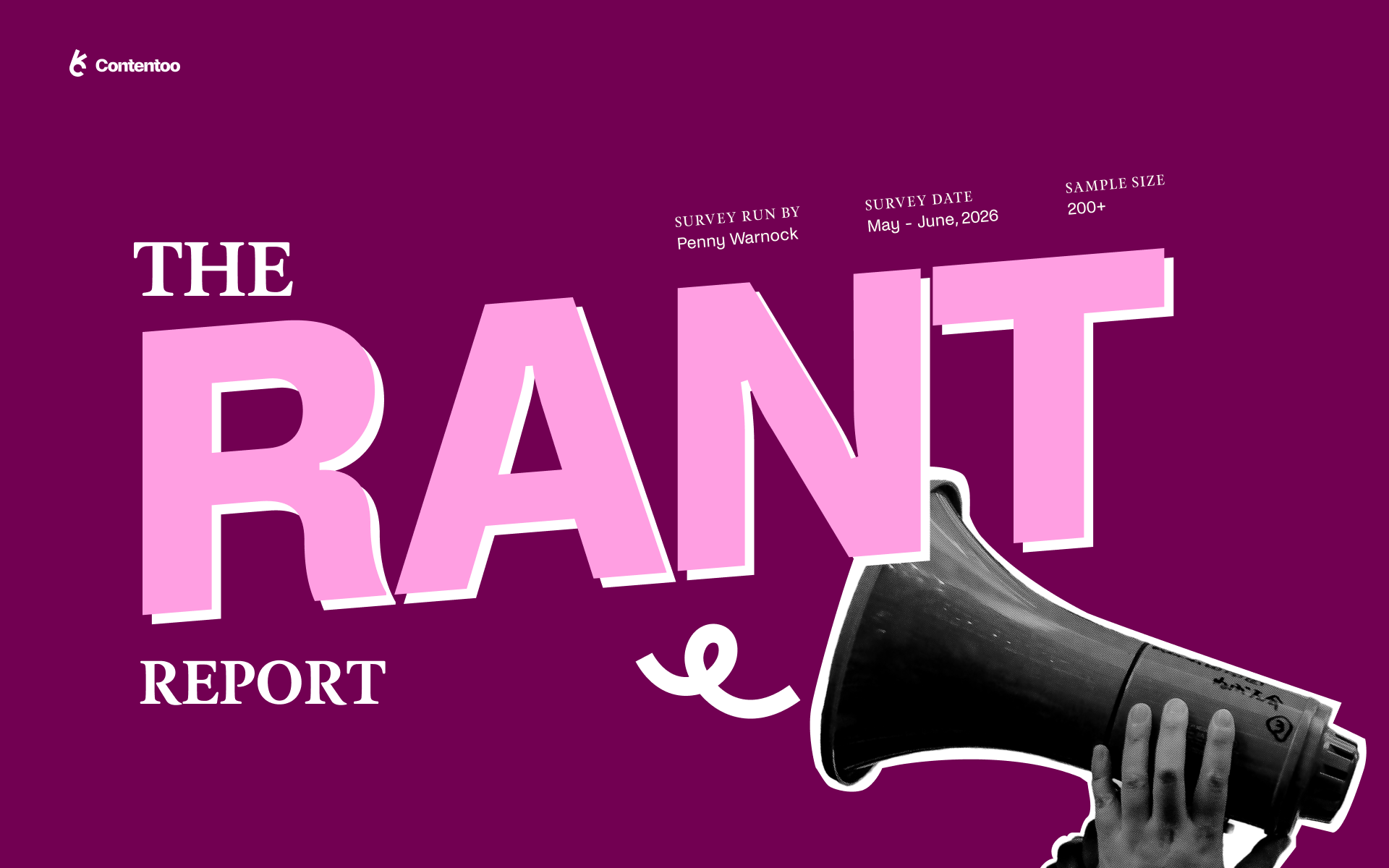
Even sophisticated AI content workflows still need human review: 95% of teams surveyed in The Rant Report always or usually keep it before publishing. AI changes who does the work, not what work needs doing. The more important question is what happens to feedback afterwards. In any AI content setup, feedback only becomes useful beyond the current draft if someone turns it into a persistent part of the system.
An editor might correct a phrase, remove an unnecessary section, or point out a missing customer perspective. That fixes the piece in front of them. To stop the same problem, someone needs to decide where that lesson belongs; it might become a Brand Kit rule, a guardrail, a workflow change, an update to a Playbook, or a new requirement in the brief.
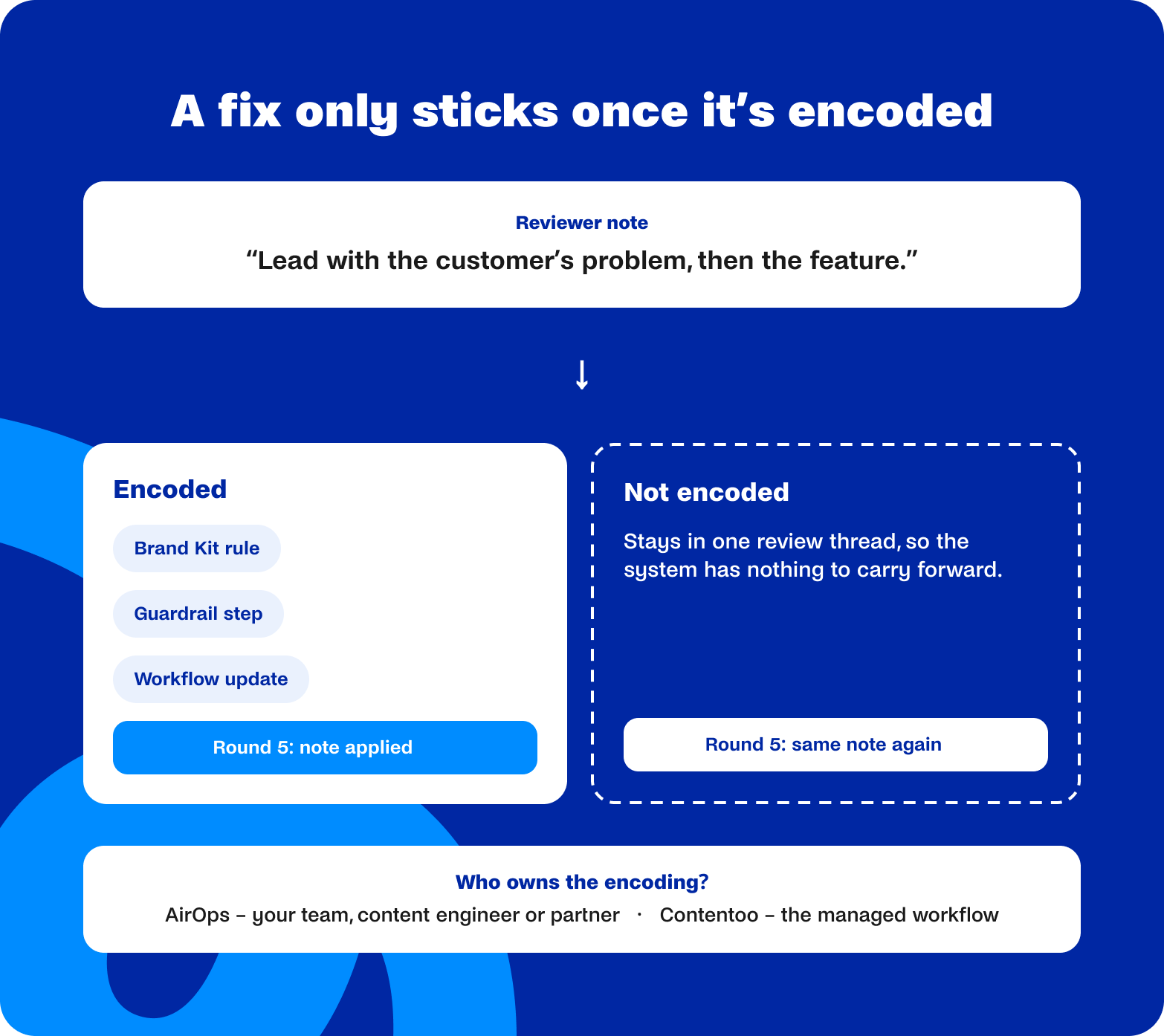
Without that step, the system has no reliable way to remember what the team has learned. Reviewers can end up making the same corrections over and over, even as the volume of AI-generated content increases.
As Simone Engbo Hansen, Content & Communications Lead at Airtame, puts it in The Rant Report: “I see working with an LLM specifically as working with a team of juniors, interns, freelancers — you are in charge of the brief. If you don’t brief it well enough, the output is going to get stuck.”
That applies beyond the brief itself. Someone remains responsible for deciding what the AI should know, what it should check, and what it should do differently next time. The editorial step still exists. The difference is who performs it and who owns the system around it.
This is where AI content production differs from simply hiring more writers: the feedback loop itself becomes part of the operating model:
- With AirOps, the team running the workflow controls how those lessons are encoded and reused. That gives experienced teams considerable flexibility, but it also means someone must own and maintain the system.
- With Contentoo, that responsibility sits within the managed workflow. Editors and subject-matter experts apply feedback during production, while the client retains strategic direction and final approval.
As content volume grows, this becomes increasingly important. Producing more drafts doesn’t necessarily reduce the amount of editorial work if the system isn’t learning from what reviewers have already said.
Depth or coverage: where does the expertise come from?
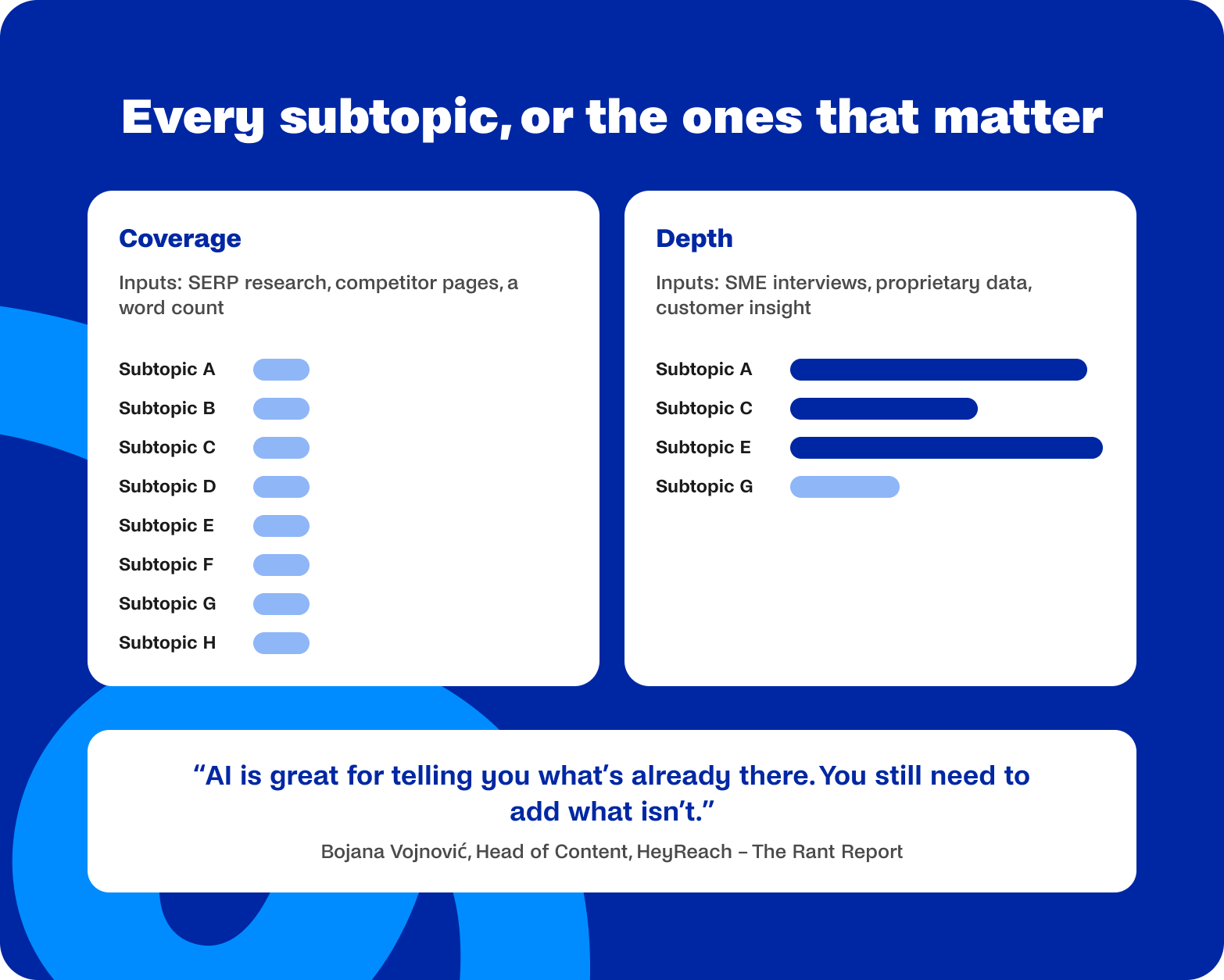
AI is very good at identifying what is already there. Give an engine search results, competitor pages, keyword data, and a target word count, and it can systematically identify the topics those sources cover. It can ensure an article addresses expected questions, includes relevant terminology, and doesn’t overlook an obvious subtopic.
But comprehensive coverage isn’t the same as depth. If those are the main inputs, an article can touch every expected subject without developing any of them particularly well. It can repeat the consensus rather than add something useful. Citations can support individual claims without giving the article a genuinely stronger argument.
The missing ingredient is usually context.
That might come from a subject-matter expert, a customer conversation, proprietary data, internal research, or a writer with enough knowledge of the subject to know what matters and what doesn’t. But simply having that information somewhere in the business isn’t enough; the workflow needs to bring it into the brief and production process at the point where it can shape the output.
The Rant Report points in the same direction. Content briefs are now the most common AI use case among the teams surveyed, with 46% using AI for briefs compared with 21% using it for drafting. At the same time, 56% identify poor or incomplete briefs as a reason content quality drops.
Taken together, those figures suggest that teams are putting more effort into the context going into production, rather than assuming the value comes from asking AI to write more. The quality ceiling is often set before the first draft exists.
AirOps’ workflows can bring knowledge bases, data sources, research, and human inputs into the production process. But the team operating the system still has to decide which expertise matters and how to structure it into the workflow.
Contentoo takes more of that responsibility into the managed production process, bringing relevant human expertise into the work alongside AI. That can include subject-matter expertise, editorial judgement, and the knowledge needed to make content useful rather than simply comprehensive.
There’s a second finding in The Rant Report that gets closer to the harder problem. 97% of teams surveyed say they’re confident in their overall content quality, yet 80% also say they regularly publish content they know isn’t good enough.

Those figures don’t mean teams lack the knowledge to recognise good content. They show a gap between confidence in the content operation and what teams actually publish. The missing ingredient can be judgement under pressure: knowing what isn’t good enough, deciding what needs another round, and having the time and authority to insist on it. That judgement becomes more important, not less, when producing a draft is easy.
What does each model actually cost to run?
The cost difference between Contentoo and AirOps isn’t best understood by comparing subscription prices, it’s about where the operating work sits. AirOps uses task-based pricing. Tasks are the unit used for certain actions in the system, and the number required depends on what a workflow does and the data it processes.
For teams that want a relatively accessible starting point, Playbooks provide pre-built, repeatable processes that can be adapted and run without building every workflow from scratch. That makes it easier for marketers to start experimenting with agent-led production.
The trade-off is that the easier route doesn’t remove the need for a sound production process underneath it. Teams still need to calibrate the output, decide where human review belongs, provide the right context, and maintain the system as requirements change.
Custom workflows offer more control over how individual steps are structured. AirOps lets teams select different models for different workflow requirements, and its newer Multi-Model functionality also allows teams to choose the model and reasoning effort for a Playbook or use AirOps’ Auto Mode.
That flexibility can help control usage, but it introduces another cost: someone needs to understand the workflow well enough to make those decisions. They need to build, test, monitor, and improve it, usually alongside the rest of their role. That person’s time is part of the cost of the system, even if it doesn’t appear on the software invoice.
The same applies when content is produced across multiple languages. Every new market can introduce another set of prompts, rules, review requirements, subject-matter inputs, and editorial checks. The task volume may increase, but so can the human effort needed to make those tasks produce useful output.
Contentoo distributes that operating cost differently. The client pays for a managed engagement, while the work of running the agreed production process sits with Contentoo. The client still supplies the context, direction, and approvals that only the business can provide, but it doesn’t need to staff the workflow itself.
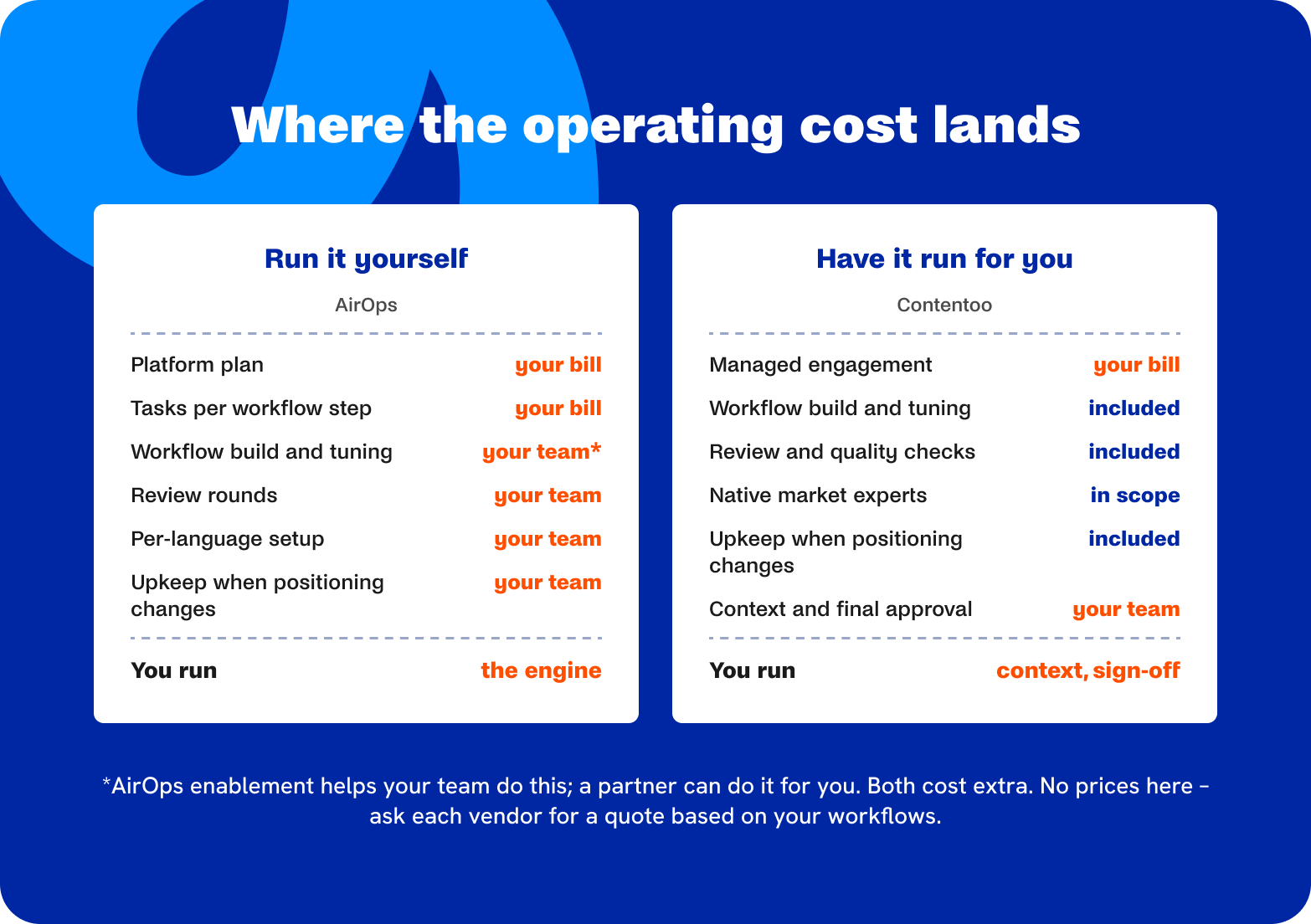
That doesn’t make one model inherently cheaper than the other. It changes what the client is paying for.
For AirOps, part of the value is owning the machinery and being able to improve it. For Contentoo, part of the value is not having to build and operate that machinery internally.
That distinction matters when you consider how much time content teams already spend coordinating work. The Rant Report found that 43% of teams spend at least 40% of their week on coordination and process. The cost of a content operation therefore isn’t just what you pay for the tools or the people producing the words. It also includes the work required to keep the whole system moving.
Which is better for multi-market localisation?
Localisation is where the difference between the two models becomes particularly visible. At enterprise scale, multilingual content isn’t simply converting one piece of copy into several languages. The content needs to retain the brand’s positioning and terminology while becoming genuinely relevant to each market. Search behaviour, examples, cultural references, regulations, customer expectations, and even the way a product is described can vary between countries.
That means localisation needs to be treated as part of production, not something that happens to the finished article.
Why AI Translation Isn’t Localisation
AI can translate remarkably well, but translation and localisation solve different problems. A translation can preserve the meaning of the source text while still sounding unnatural in the target market. Idioms and metaphors can carry over badly. Examples that make sense in one country may feel irrelevant in another. A statistic may need a different source, a search term may not be used by local customers, and a claim may need to account for market-specific regulation.
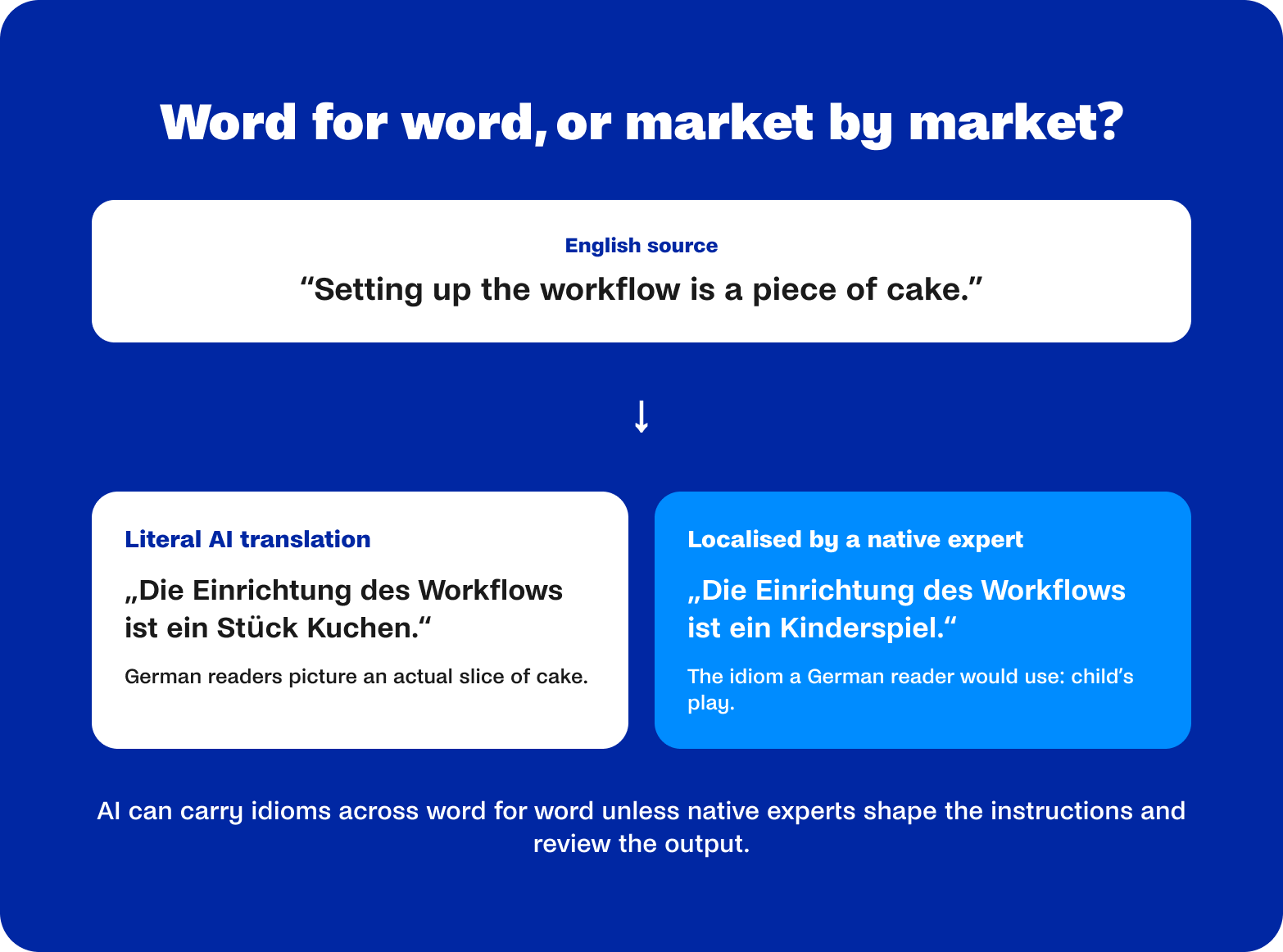
AI can handle many of those tasks when it has the right context. But that context has to come from somewhere.
Native-language expertise needs to shape the instructions, identify what needs to change for the market, and review whether the finished content actually sounds as though it belongs there. That doesn’t mean every sentence needs to be rewritten manually. It means someone with genuine market knowledge needs to own the judgement calls.
📌 Worth reading: For a deeper look at the distinction, check out our guide on Translation vs Localisation: When to use each.
What Localising with AirOps Requires
AirOps can handle multilingual, multi-region content, but good localisation still depends on the workflow around it. Someone needs to define the language-specific requirements, provide the relevant market context, establish the rules the workflow should follow, and review the output. The more markets you add, the more of those requirements need to be represented in the system.
That can work well for a team with the right expertise. A content engineer can build the workflow, while native-speaking editors or subject-matter experts provide the market knowledge and review the output. The two roles can work together, with the engineering layer making the process repeatable and the local expert providing the judgement. A partner can take on the content engineering side, but the native-language judgement still has to come from someone. Ask whether that’s the partner, freelancers they coordinate, or your own market teams.
The important question is therefore less “Can AirOps produce French, German, or Dutch content?” and more “Who in your organisation is going to make sure the French, German, or Dutch content is actually good?”
AirOps is headquartered in the US, with offices in New York and San Francisco and an additional office in Montevideo, alongside a distributed team. It is also increasingly focused on helping brands operate across AI search and international markets.
So this isn’t a question of whether AirOps can support European content. It can. The consideration for a buyer is where the native market expertise sits and who is responsible for incorporating it into the workflow.
How Contentoo localises inside the workflow
Contentoo takes a different approach by putting native-language expertise inside the production process. That means localisation can happen alongside briefing, writing, editing, optimisation, and quality control, rather than being treated as a separate translation task at the end. AI can still be used where it adds value, but native experts remain responsible for the market-specific judgement.
That model is particularly relevant when localisation is one part of a wider content operation. The client doesn’t need to build a separate content-engineering process for every language or hire someone internally to maintain it. Contentoo manages the production process while the client retains the strategic context and final approval.
Contentoo supports global content creation across 49+ languages, giving teams a single managed workflow for multilingual content rather than requiring them to build and maintain separate production processes for every market. That makes the model particularly suited to organisations where localisation is part of ongoing content operations rather than an occasional translation project.
Its work with tado° illustrates the scale at which this becomes useful. The company expanded content across 7+ markets and more than 10 languages, while its internal team was already stretched by the demands of producing market-specific content. The challenge wasn’t simply translating more quickly. It was producing content that felt natural and relevant in each market while maintaining consistency across the brand.
That’s the underlying qualifier for the managed model: complexity.
The more markets, languages, stakeholders, subject-matter experts, and production requirements you add, the more valuable it becomes to have the operating layer managed rather than built and maintained internally.
For European companies expanding across neighbouring markets, that distinction can be particularly important. Contentoo was built in Europe and has native expertise across the markets where many of these localisation challenges occur. Its current market-expansion offering positions native-speaking experts as part of the support for entering new markets.
Which should you choose: Contentoo or AirOps?
There isn’t a universal winner between Contentoo and AirOps. The more useful questions are who will own the workflow and how complex that workflow needs to become.
When to choose AirOps
Choose self-operated AirOps if you have the content engineering, SEO operations or technical content capacity to build and improve an AI content engine yourself. It’s particularly well suited to AI search visibility, large-scale content refreshes and repeatable optimisation programmes, and to teams for whom owning the system is part of the value.
Choose AirOps with AirOps’ enablement if you want to own the engine but need help getting there. Solution architects and training can shorten the learning curve, while your team stays responsible for running and improving the system.
Consider a partner-run AirOps engagement if you specifically want AirOps’ platform without the operational load. Then compare it with a managed service on the same terms: who supplies subject-matter and market expertise, who carries feedback forward, and what you keep if the engagement ends.
When to choose Contentoo
Choose Contentoo if content production has become a coordination problem as much as a writing problem, and you want one provider responsible for the whole production workflow (briefing, expert input, editing, localisation and quality control) rather than a platform with services built around it.
That’s especially relevant when your content spans several markets and languages, depends on subject-matter experts, involves multiple stakeholders, or has grown beyond what your existing team can comfortably handle.
The managed model is designed for teams that want to provide the context, strategic direction, and approval without taking responsibility for the production machinery in between.
That can be particularly valuable for European and international teams where localisation is a core part of content production. Instead of building and maintaining separate processes around every market, native expertise is brought into the managed workflow.
The more complex the operation becomes, the stronger that case gets.
When it makes sense to run both
The two models don’t have to be mutually exclusive. A team could use AirOps for AI search visibility, large-scale content analysis, and repeatable refresh programmes, while using Contentoo for net-new expert content, complex production, or localisation.
The useful dividing line is ownership. That applies even if a partner runs your AirOps workflows: you still need to decide which outcomes each provider is accountable for.
AirOps can own a particular workflow because your team wants the control and has the capacity to operate it. Contentoo can own another because the production complexity makes managed execution more valuable.
For some enterprise teams, the right answer won’t be choosing one model for everything. It will be deciding which parts of the content operation they want to build themselves and which they would rather have someone else run.
What to Ask in a Demo, Whichever You Choose
A good demo should show you more than what the AI tools can produce. It should show you what happens when the workflow meets the messy parts of real content production: changing positioning, conflicting feedback, multiple markets, human review, and the need to reject work that isn’t good enough.
Before choosing between AirOps, Contentoo, or other AirOps alternatives, ask:
- What happens to round-one feedback by round five? Ask the vendor to show you exactly where a correction becomes a persistent rule, workflow instruction, brand governance requirement, or other part of the system rather than relying on someone to remember it.
- Who maintains the workflow when your positioning changes? Your brand voice, products, audience, and search strategy won’t stay static, so decide whether your team, a content engineer, or a dedicated account manager owns keeping the system aligned.
- Who adapts the content for each market? If you’re producing multilingual content, ask who supplies the local expertise, who checks brand consistency and local relevance, and what happens when the same workflow needs to support several languages.
- How much human editing should you realistically expect? Don’t settle for a demonstration of an impressive first draft; ask what human review looks like before content becomes publish-ready and who is expected to make the final quality judgement.
- How does usage turn into cost? Ask what counts towards usage, how additional AI tools or workflow steps affect consumption, whether bulk execution changes the economics, and what happens when your content operation grows.
- What exactly does the service cover? If AirOps or a partner is involved, ask which workflow steps they build, which they run, what expertise they supply, and what stays with your team.
The answers tell you more than a feature comparison. A content engineering platform can give an experienced team control over its workflows, AI search data, and automation, while a managed service can take more of the operational work off the team’s hands. Neither removes the need for judgement.
The system worth paying for is the one that remembers your standards, carries them into the next piece, and makes it clear who is responsible when those standards change.
Still weighing up whether a managed content workflow is right for your team? Book a demo with Contentoo to explore how you can scale content production across markets without adding the operational burden of running the workflow yourself.
Frequently asked questions about Contentoo and AirOps
What is the main difference between Contentoo and AirOps?
The main difference is who owns the content workflow and what’s included in the engagement. AirOps is a platform your team can operate alone, with support from AirOps’ solution architects and training, or through a partner that builds and runs workflows for you. Contentoo runs a managed content workflow, combining AI agents and human expertise, including native-language experts, while your team provides strategic direction, context and final approval.
Is AirOps a good alternative to a managed content service?
Yes, if your team has the expertise and capacity to operate an AI content engine. If you don’t have that capacity, AirOps partners can build or run workflows for you, but check whether their scope covers subject-matter expertise, editorial review and localisation as well as the platform itself. AirOps can also be a strong fit for in-house SEO teams and content operations teams that want to control workflows, connect AI search data, and automate content production or optimisation. A managed service is likely to be a better fit if your team wants to approve quality content without taking responsibility for building and maintaining the workflow itself.
Do I need a content engineer to get good results from AirOps?
Not necessarily, but the more sophisticated your workflow becomes, the more useful content engineering expertise is. AirOps provides Playbooks and other prebuilt capabilities that can reduce the learning curve, while its workflow builder gives experienced teams more control over how content research, AI generation, review, and publishing work together. The key question is who will own the system as your requirements change.
Can Contentoo and AirOps be used together?
Yes. A team could use AirOps for AI search visibility, content analysis, SEO research, and large-scale content refreshes while using Contentoo for net-new expert content, complex production, or localisation. AirOps can integrate with other tools and systems, so the decision is less about choosing one tool for everything and more about deciding who owns each part of the content operation.
Which is better for multi-language content and localisation?
Both can support multilingual content, but they place the localisation responsibility in different places. AirOps gives teams the tools to build and operate language-specific workflows, while Contentoo brings native-language experts into the managed production process. For organisations working across several markets, the deciding factor is often whether they already have the people and processes needed to maintain local expertise, brand consistency, and quality across each market.
How does AirOps pricing compare with a managed content workflow?
AirOps uses task-based pricing, so costs depend on how much work your workflows perform and the amount of AI processing, data, and other actions involved. A managed content workflow charges for the service of running production, with the operational effort sitting with the provider instead of the client. The better comparison is therefore not simply software cost versus service cost, but the total cost of the people, tools, workflow management, and review required to produce the content.
Does Contentoo use AI agents or human writers?
Contentoo uses both. AI agents can handle parts of the workflow such as drafting, checking, and routing, while human experts provide subject-matter knowledge, editorial judgement, localisation, and quality control. The client retains strategic direction and final approval, so the model combines AI-assisted production with human oversight rather than treating AI and human writers as alternatives.