The modern guide to video and branded content production in 2026


TL;DR
This article is for B2B marketing leaders who already believe in video but can't make production reliable. The central argument: process without creativity gives you reliable mediocrity, and creativity without process gives you expensive one-offs that can't be repeated. Video multiplies every failure point a normal content team already has: more stakeholders, more approval rounds, more room for a vague brief to turn into a reshoot. The fix is building the infrastructure, a brief that captures the actual creative idea, a four-phase workflow with explicit handoffs, and a persistent talent model where context survives whoever's executing, so creative work is protected well enough to happen reliably, not just once.
The budget was signed. The stakeholders were aligned. The marketing lead had three months to deliver a suite of branded videos for the product launch. Six weeks later, the project was three rounds deep in revisions, two external partners had already cycled out, and the original brief had been rewritten so many times that no one could remember what the video was supposed to do in the first place.
This scene plays out across B2B marketing teams more often than anyone admits. One project goes smoothly because a particular freelancer understood the brief. The next collapses because that freelancer wasn't available and no one had documented what “understood the brief” actually meant.
The market talks about branded video in creative terms: storytelling, emotional connection, brand identity. And that's not wrong, a perfect workflow can still reliably produce something nobody wants to watch. But the day-to-day reality most teams are actually fighting is a coordination problem sitting underneath the creative one: multiple stakeholders, external producers, review rounds, no clear process from brief to finished deliverable. The brief is usually the first thing that breaks, and everything downstream breaks faster once it does.
Creative ambition without infrastructure produces one-off successes that can't be repeated. Infrastructure without creative ambition produces reliable mediocrity. Neither is the goal. This guide is about the system that lets good creative work happen more than once: what a sound production process looks like, where most teams go wrong, and how the process protects the creative thinking instead of replacing it.
More parties, higher stakes: why video breaks differently
A written article typically involves two or three parties: a writer, an editor, and perhaps a subject-matter reviewer. A branded video brief can involve a scriptwriter, a director, on-camera talent or actors, an editor, a sound designer, a motion graphics artist, and multiple client stakeholders, often all touching the same brief. Each handoff is a failure point. Ask any relay swimmer: the race is lost at the wall, in the half-second where one hand has to find another.
Unclear briefs cause bad content in writing too, that's not unique to video. The real difference is what ambiguity costs once it survives into production, and how far it travels before anyone can afford to catch it. A vague sentence in a draft is cheap to rewrite; nobody's booked a studio for it.
A vague shot list discovered on set means a reshoot, a crew day, and a client stakeholder who has to explain the delay upward. Video doesn't need more clarity than writing does; the cost of unclarity simply compounds at every stage it survives, and video has more stages than almost anything else a content team produces.
Consider the approval process. Three different surveys, three different formats, the same finding: review and coordination eat the week.
- Adobe (2025): 58% of marketers spend more than 40% of their time managing reviews and approvals rather than creating.
- Knak (2026): 82% of enterprise marketing teams spend at least half their time on production rather than strategy, 60% say four or more people are involved in producing a single asset, and 69% cycle through two to three rounds of revision before anything gets approved.
- Contentoo (2026): 43% of leaders spend more than 40% of their week on coordination and process.
For video specifically, this compounds. Adobe's research found that 89% of marketers say content passes through three or more approval stages, and nearly half report that a single asset can involve 51 to 200 people. That's a small country's cabinet meeting over how to colour-grade a testimonial. Video, with its visual, audio, and narrative dimensions, attracts more reviewers and more opinions than almost any other content format. Knak's report found a similar pattern on the approval side alone: 47% of marketing teams cite approvals and sign-off as their single biggest challenge to launching on time, closely matching the 45% of teams who told Contentoo that internal review and approvals is their top-cited content bottleneck overall. Video doesn't create a new problem. It takes the review bottleneck every content team already hasand multiplies the stakeholder count.
This is an argument for treating video production as the complex, multi-party operation it actually is, and for protecting the creative work happening inside that operation. A bigger production budget doesn't fix a broken process. It just funds a more expensive version of the same mistakes, and a great creative idea shot through a broken process is exactly as fragile as a mediocre one.
The pre-production phase, from content brief to final shoot-ready script, is where most failures originate. An external production team can't deliver to standard if the brief doesn't define what “to standard” means. A feedback loop that happens after the shoot is too late. The infrastructure has to exist before the camera rolls.
TLDR: The more parties involved in production, the more a broken process costs. Video involves more parties than almost anything else a content team produces.
Three wrong turns that undercut video before it starts
The core mistake is letting creative ambition and process compete instead of building one to protect the other. Three specific wrong turns show up again and again.
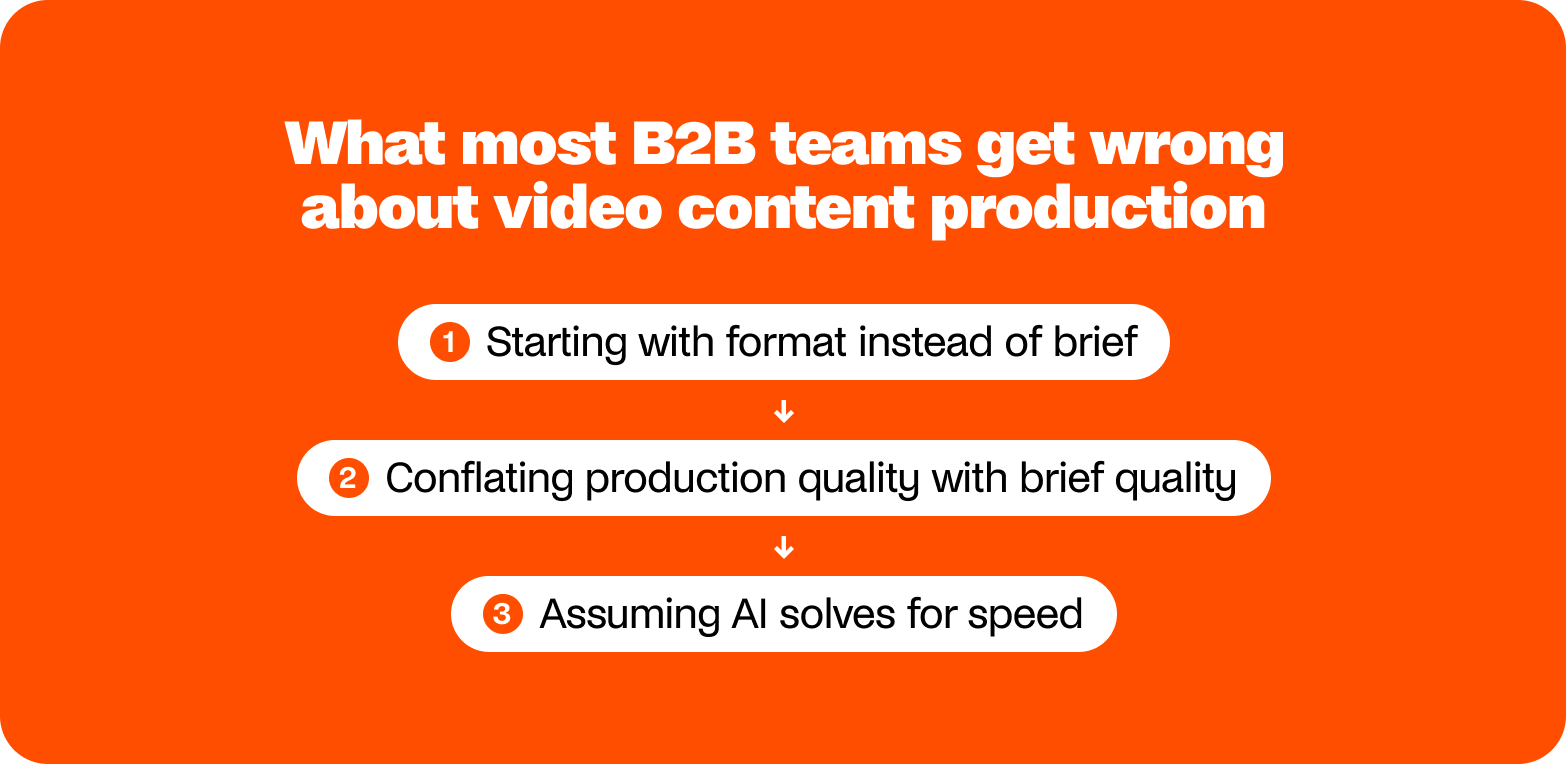
1. Starting with format instead of brief
Teams decide they want a two-minute explainer or a set of social clips before they've defined the audience, the CTA, or the distribution context. Format is a downstream decision: it follows from what you want the video to accomplish, who you want to reach, and where they'll encounter it. When you start with format, you end up forcing content into a container that may not fit, then discovering the mismatch in post-production when it's expensive to change.
2. Conflating production quality with brief quality
A technically excellent video built on a vague brief will still miss the mark. High production values are not a substitute for clear thinking about what the video needs to say, to whom, and why they should care. A strong brief forces a clear answer to one question: what is the one thing this video needs the audience to understand, feel, or do? Not every video needs a controversial point of view. A product demo doesn't. A customer story doesn't. But every video needs that single, specific target, or the crew is shooting toward nothing in particular. Polish can't substitute for that clarity, and brand guidelines can't compensate for a brief that never defined it. Teams invest in better cameras, better editors, better motion graphics, and then wonder why the final asset doesn't perform. The problem sat in the content brief the whole time, not the edit suite.
3. Assuming AI solves for speed
AI adoption in video production is no longer in question, most teams already use it somewhere in the workflow. What matters is where. AI is a genuine accelerant for transcription, rough-cut assembly, scripting drafts, subtitle generation, and repurposing a hero video into short-form clips: work that's largely mechanical once the creative decisions are made. It is not a substitute for the judgment calls that decide whether the video is any good in the first place: what the story is, whether the performance lands, whether the cut serves the idea. Point AI at the mechanical layer and it saves real time. Point it at the creative layer, hoping it'll compensate for a vague brief or an unclear idea, and it just produces a faster, more polished version of nothing in particular.
The underlying pattern across all three mistakes: treating symptoms instead of causes. Format flexibility, production quality, and AI tooling are all useful. None of them fix a content operations problem, and video production, at its core, is an operations problem protecting a creative one.
TLDR: Most video production problems are diagnosed as creative problems. They are almost always brief and process problems in disguise, but the process exists to protect the creative work, not replace it.
What the brief actually is, and why it's the most underrated production tool
A brief is a thinking process, closer to a tailor taking measurements before touching the cloth: skip it, and no amount of skilled stitching saves the fit. The value isn't in the artefact itself but in the moment of thinking the brief forces: the pause to define what you actually want to do before anyone starts doing it.
That thinking process, done properly, is a creative strategy exercise, not a production spec. A brief worth acting on should work through, in order:
- The objective. What is this video actually meant to achieve for the business?
- The audience, specifically enough that a scriptwriter can picture one real viewer, not a segment label.
- The audience insight. What does that viewer actually believe, want, or struggle with, that the video can speak to honestly?
- The single-minded proposition. One idea the whole video has to land, not three good ones competing for the same 90 seconds.
- The creative idea. How that proposition actually gets brought to life, the story, the device, the hook, not just the message it's meant to carry.
- The desired response. What should the viewer understand, feel, or do once it's over?
- Distribution context. Where they'll encounter it, and what that means for format, length, and pacing.
- References. Concrete examples of the tone or style being aimed for, not adjectives describing it.
- Mandatory brand elements, so casting, colour, and compliance aren't afterthoughts discovered in the edit.
- Deliverables and success criteria, agreed before the shoot, not negotiated after.
Most video briefs cover two or three of these. The result is a production process that loops back, rewrites, reshoots, or re-edits, because the parts that were skipped were never optional, they were the parts that make it a brief instead of an assignment.
What a good video brief is: a forcing function that makes everyone agree on what the video is for, who it's for, and what success looks like before any production work begins. It captures the creative intent and the operational constraints in a single document that an external production team can act on without guessing, and without having to reconstruct the thinking that should have already been done.
What a good video brief is not: a production checklist wearing the word “brief.” A brief that can't be signed off internally can't be produced to standard externally.
Consider the downstream cost of a weak brief:
- A scriptwriter who doesn't know the single-minded proposition writes a script trying to say three things at once.
- A director who doesn't know the distribution context shoots for the wrong aspect ratio.
- An editor who doesn't know the desired response buries the call-to-action at the end of a three-minute video that most viewers won't finish.
Each of these is a fixable problem, but the fix happens in post-production, where it costs time and money, instead of in pre-production, where it costs a conversation.
The brief-as-thinking-process matters even more when you work with external talent. Onboarding external content creators who can produce to standard on their first assignment depends on the brief carrying the weight, since they weren't in your strategy meetings and don't have ambient context about your brand. Everything they need to know must be in the document, or you'll spend the production phase teaching them what you should have told them in the brief.
Visual content production, from thumbnail to final master, flows from brief quality. Brand guidelines provide the guardrails, but the brief provides the direction and the creative idea itself. Without it, even the best editorial workflow produces content that's technically correct but strategically misaligned.
The workflow: from brief to published asset without losing the thread
A sound branded content video production workflow moves through four phases: pre-production, production, post-production, and distribution. The phases aren't novel. What separates functional teams from chaotic ones is how explicitly each phase is defined and where the handoffs happen.
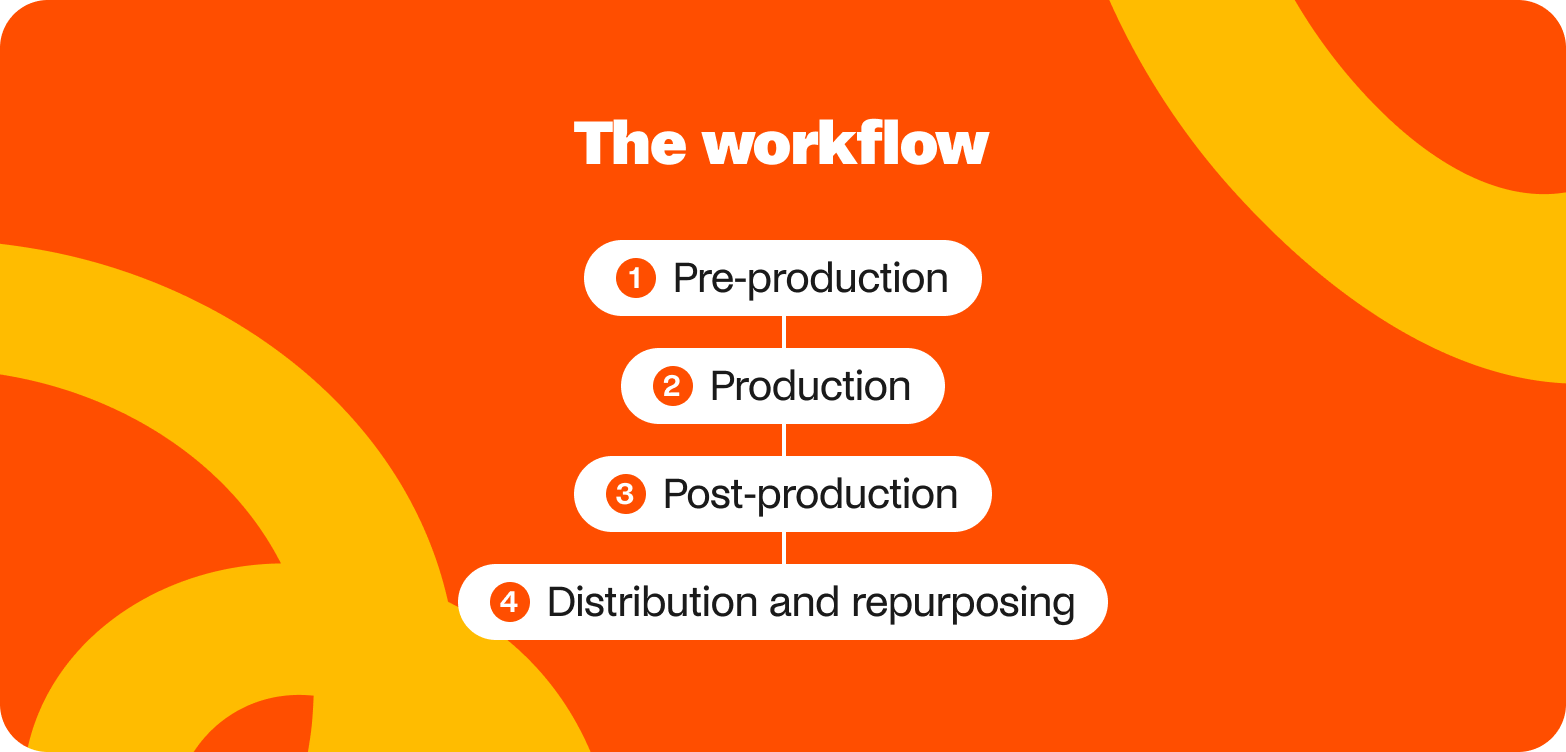
Pre-production
Pre-production covers everything from brief development through shoot-ready assets. Three things anchor it:
- The brief itself, signed off by stakeholders before any external work begins.
- Script development, usually two or three rounds with clear revision gates so feedback doesn't arrive after the shoot.
- Storyboarding or shot lists, especially for complex shoots where a shared visual reference stops costly misreads on set.
Two more pieces round out the phase. Talent briefing gives presenters, actors, or spokespeople on-brand direction before they arrive, so the shoot day is spent capturing rather than explaining. A production schedule with real logistics, from location to kit to sign-off windows, keeps the whole thing from slipping.
The most common failure here is treating pre-production as an informal phase that happens in emails and Slack threads. Pre-production is where you catch problems cheaply. Every ambiguity that survives into production becomes expensive to fix.
Production
Production is the shoot itself, plus any asset capture that happens alongside it. Three things run in parallel:
- Direction and capture that follow the storyboard rather than improvising the plan on the day.
- B-roll and supplementary footage shot deliberately for later repurposing, not grabbed as an afterthought.
- On-set quality checks against the brief, so a mismatch gets caught while the crew is still in the room.
Live content production raises the stakes further, since real-time coordination leaves almost no room to fix a mistake after the fact. A well-run production phase generates more than a single deliverable. It captures the raw material for short-form video, social cuts, and derivative formats, and that has to be planned at the brief stage.
Post-production
Post-production is where raw footage becomes a finished asset. The sequence tends to run in a set order:
- Rough cut assembly, where the story takes shape and structural problems surface before anyone polishes a frame.
- Motion graphics and visual effects, layered in once the edit is locked enough to build against.
- Sound design and music, which carry more of the emotional weight than most briefs credit.
Colour grading and caption or subtitle integration close the phase. If you plan to add subtitles to your videos, that decision should be made in pre-production so the edit accommodates text overlays cleanly, since subtitles added as an afterthought often conflict with lower-third graphics or squeeze into formats that were never designed for them.
Distribution and repurposing
A single piece of multimedia content production should produce multiple assets: the hero video, short-form clips, social crops, audio extracts, and still frames for thumbnails or promotional graphics. Video distribution works better when these formats are planned at the brief stage.
Content repurposing is where production efficiency compounds. A three-minute branded video can yield six to ten derivative assets if the shoot was planned for it. Most teams produce one video and then scramble to create social cuts from footage that was never framed for vertical formats. A dedicated approach to short-form content makes this repeatable instead of ad hoc, and the fundamentals of short-form video specifically are worth knowing before you plan the shoot.
Producing output faster doesn't make thinking faster. Ideas take the time they take. The workflow has to accommodate the full asset map from the start.
Managing quality and consistency when external talent is the norm
Most B2B teams don't have in-house video production capability. They work with freelancers, production houses, or agencies, often a different combination for each project.
According to 10Fold's 2025 research, 88% of B2B tech executives rely on outside partners for at least some content, and 86% prefer a hybrid model mixing internal and external resources. Wistia's 2026 State of Video report found that roughly one in four companies outsource video creation to freelancers or agencies.
This creates a specific operational challenge, and it's a different one than it first appears. The obvious framing is “how do we keep working with the same good freelancer.” The real problem sits underneath that: every time a new director, editor, or writer joins a project, someone has to re-download an entire brand from their own head, brand voice, past feedback, what's worked before, what's been tried and rejected, because none of that context lives anywhere except in whoever executed the last project.
Persistent context, not a fixed roster
The answer isn't finding a single perfect supplier and hoping they stay available forever. That's a risk concentration strategy, not a quality strategy, and it doesn't solve the actual problem: it just delays the moment someone new has to be onboarded from zero. The real fix is making the context persistent independent of who's executing: the brand standards, the feedback history, the reference examples, the workflow itself should all outlive any single contributor, so a new director or editor inherits the accumulated knowledge instead of starting the relationship from scratch.
This isn't an argument that talent is interchangeable, and it shouldn't be read as one. A system that carries context forward reduces how much quality depends on luck or ambient knowledge that happened to live in one person's head. It doesn't erase the difference between an average creative partner and an excellent one. Matching the right creative expertise to the specific job still matters enormously, particularly in video, where a director's eye or an editor's instinct for pacing isn't something a brief can fully substitute for. What good infrastructure does is make good talent more consistently successful, freeing them to spend their time on the creative judgment only they can bring, instead of relearning your brand from a Slack thread.
The managed model versus ad-hoc sourcing
Ad-hoc sourcing treats each video project as a standalone procurement exercise. You find a freelancer or agency, negotiate terms, hand over the brief, and hope for the best. When the project ends, the relationship ends, and the next project starts from zero. It's less a partnership than a string of first dates that never get a second.
A managed model treats the operation itself as ongoing infrastructure, not just the relationship with one supplier. You invest in documenting brand standards, feedback history, and quality expectations once, and that record persists regardless of which specific contributor executes the next project. The brief carries more weight because whoever's on it can draw on accumulated context rather than starting cold, and revisions decrease because expectations are explicit and already proven to work.
The managed model requires more setup cost. It pays back in reduced project overhead, faster turnaround, and more consistent output, without narrowing who you can bring in to do the work. Comparing production management platforms is a useful next step once you've decided which model fits.
Where quality standards live
Quality standards have to be baked into the brief and the review process. They can't be left to the talent to infer. This means defining a few things up front:
- What “on-brand” looks like for video, shown with examples rather than described in the abstract.
- Revision governance: how many rounds are included, what counts as a scope change, and how feedback is structured.
- Acceptance criteria: what the final asset must include to be considered complete.
Asset management expectations belong in the same document, covering file naming, format delivery, and archiving so nothing gets lost between the editor's timeline and your library. A content post-production service can handle the technical execution, but the quality definition has to come from the client side. If you don't define what good looks like, you can't complain when you don't get it.
The feedback loop is the final quality mechanism, and it's also part of what should persist across projects rather than resetting each time. Structured feedback, specific rather than subjective, reduces the most common failure points in media production for content creators who are external to your organisation. “Make it feel more dynamic” is not feedback. “Increase the pacing in the first 30 seconds to match the energy of our brand reference video” is feedback, and it's worth more the second time a partner hears it, not just the first.
When external talent changes project to project, consistency lives in the context that persists, not in re-finding the same person.
What this means for your team
The argument across this guide reduces to a single claim: branded video content production needs an operational system, not so operations wins over creative ambition, but so creative ambition survives contact with a deadline, a budget, and six stakeholders. Once you build that system, three things change:
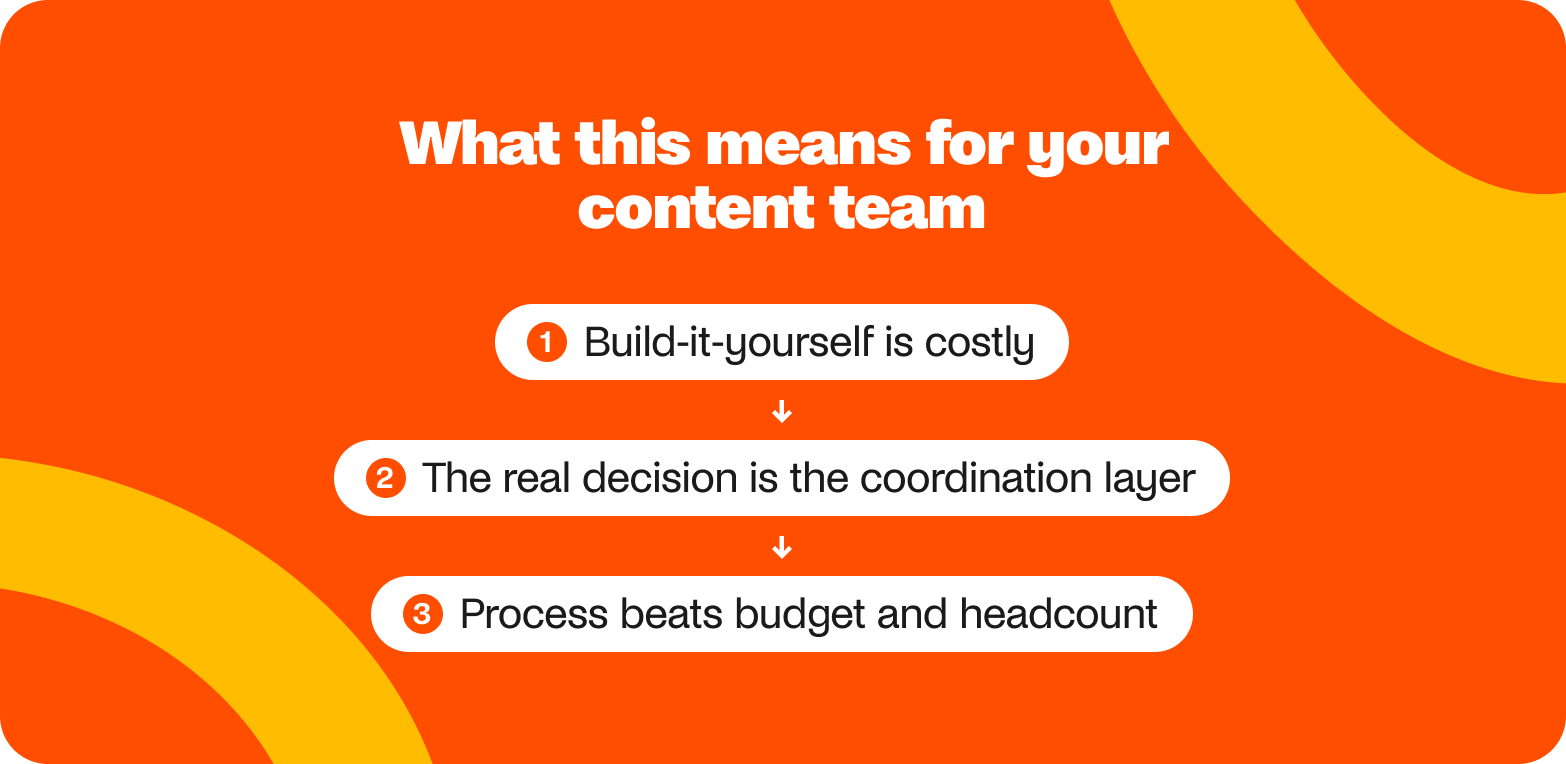
- You can realistically plan and budget for video. A sound brief process gives you scope early. You know what you're making, for whom, in what formats, before you commit production resources. This means fewer surprises, fewer scope changes mid-project, and more accurate cost estimates. Video content production stops being a black box that always runs over budget.
- You can scale without proportionally scaling headcount. If you want to scale content production without hiring, the workflow has to be replicable. A process that depends on a specific person's knowledge or a specific supplier's relationship doesn't scale. A documented, managed process, where context persists independent of who's executing, does. Teams that treat video as a system can increase volume without increasing chaos.
- Quality becomes more consistent, and creative work gets the room to actually be good. When standards and context are embedded in the process rather than living in one person's head, the right creative talent spends less time reconstructing your brand and more time doing the work only they can do. This is the difference between hoping the next freelancer happens to get it, and building a system where getting it is the expected outcome.
When Bloomreach needed to localise content across EMEA without overwhelming its internal team, the fix wasn't a bigger internal hire, it was a managed process built on the same principles this guide has walked through: a clear brief, a persistent standard for quality that outlived any one contributor, and vetted talent matched to the actual creative need.
The result was localisation turnaround cut from weeks to days and a 3x increase in leads. See how Bloomreach did it, or explore Contentoo's video production service directly.
For teams already investing in short-form content or exploring video as a growth channel, the operational infrastructure matters as much as the creative ambition, because one without the other doesn't hold. Creative ambition without infrastructure produces one-off successes that can't be repeated. Infrastructure without creative ambition produces reliable mediocrity. The goal is a system that lets great creative work happen again and again, because the process underneath it doesn't break.
Successful teams have built the infrastructure: the brief template, the workflow documentation, the revision policy, the quality checklist. The creative work gets all the attention. The operational work is what makes the creative work repeatable.
Contentoo's video production workflow covers scripting, production management, post-production, and repurposing, designed to take B2B marketing teams from brief to finished asset without the operational overhead. Book a demo to see how it works.
FAQs
How much does branded content video production cost?
Costs vary widely by format, production complexity, and whether talent is in-house or external, so any specific price range is less useful than the question underneath it: can the process generate multiple asset types from a single shoot? That's what actually determines cost per asset. A shoot planned upfront for six to ten derivative formats costs less per finished piece than the same shoot planned for a single hero video, even at an identical day rate for the crew.
What's the difference between branded video content production and traditional advertising?
Traditional advertising starts from a product claim. Branded video content production starts from an audience need: what the viewer wants to watch, learn, or feel. The brand's presence is earned through the value the content creates. The operational difference is that branded content requires a more detailed brief, a longer editorial process, and a different quality standard for what “done” means.
What are the most common bottlenecks in video content production?
Internal review and approvals, unclear briefs, and first-draft quality are the most common bottlenecks, the same pattern Contentoo's own research and a 2026 Knak report both point to, with 45% and 47% of teams respectively naming review and approvals their top challenge. For video, these compound because of the number of external parties involved: each approval stage adds time, and without a documented process for handling revisions, production loops multiply. The brief is usually where the system first breaks down.
How do you manage branded video content production with external suppliers?
Treat the brief as a quality gate before any external work starts. If the brief can't be signed off internally, the supplier can't produce to standard. Beyond the brief, document a clear revision policy: how many rounds, what constitutes a scope change, how feedback is delivered. Structured, specific feedback reduces the most common failure points in external production relationships.
What is a content post-production service?
A content post-production service covers the editing, sound design, motion graphics, colour grading, and format output stages that follow a shoot. For branded content, this often includes creating multiple format versions, such as long-form, short cuts, and social crops, from a single master edit. Some content production platforms provide post-production as part of an end-to-end managed service, integrating it with brief development and quality review.
How do you scale branded content video production without increasing headcount?
Scaling video production without proportional headcount growth requires three things: a repeatable brief process so scope doesn't creep on every project, a managed external talent model so you aren't rebuilding the team for each brief, and multi-format planning at the start so each shoot produces a suite of assets rather than a single deliverable. Workflow infrastructure, not creative talent alone, is the rate-limiting factor for volume.








.webp)