9 content marketing workflow examples that work in 2026


TL;DR
Content teams rarely stall on the writing itself. The week goes on everything around it: briefing, finding the right expertise, chasing people, approvals, localisation, holding quality, managing external talent, and getting finished work live. Each of those problems has its own structural cause, so each needs its own workflow choice. This article walks through nine content marketing workflow examples, each built to remove one specific pain, plus a quick diagnostic to find the one costing you most. The test of a good workflow is how much work it takes out from around your content.
It's Thursday. You've spent the morning nudging a reviewer who promised on Monday to "look at it today". A new freelancer needs the brand explained again, from the top. The German version of last month's launch piece is stuck in a queue somewhere, and the article everyone agreed was nearly done a fortnight ago still hasn't gone live.
None of that is writing, yet it's where the week went. Your content marketing workflow probably lists every stage from brief to publish in a tidy row. The trouble lives in the gaps between those stages, the way water finds the cracks in a wall long before anyone notices the damp.
Plenty of content leaders will recognise that Thursday. In The Rant Report, Contentoo's State of Content Teams 2026 research, 43% of content leaders said they spend 40% or more of their week on coordination and process instead of strategy or creative work.
So this article skips the stages. It starts with the pains: nine of them, each with the structural reason it keeps coming back and a workflow designed to remove it. Pick the one that sounds most like your Thursday.
Why content workflows break in the work around the writing
A documented workflow is a map drawn before anyone walked the route. It shows where the work should go, and it says little about where the work gets stuck.
The Rant Report bears that out. 65% of teams say they have a fully documented content workflow, yet 76% of those same teams still regularly publish content they know isn't good enough. Having a process written down and having one that reflects how work moves are two different things, and the gap between them is where quality leaks out.
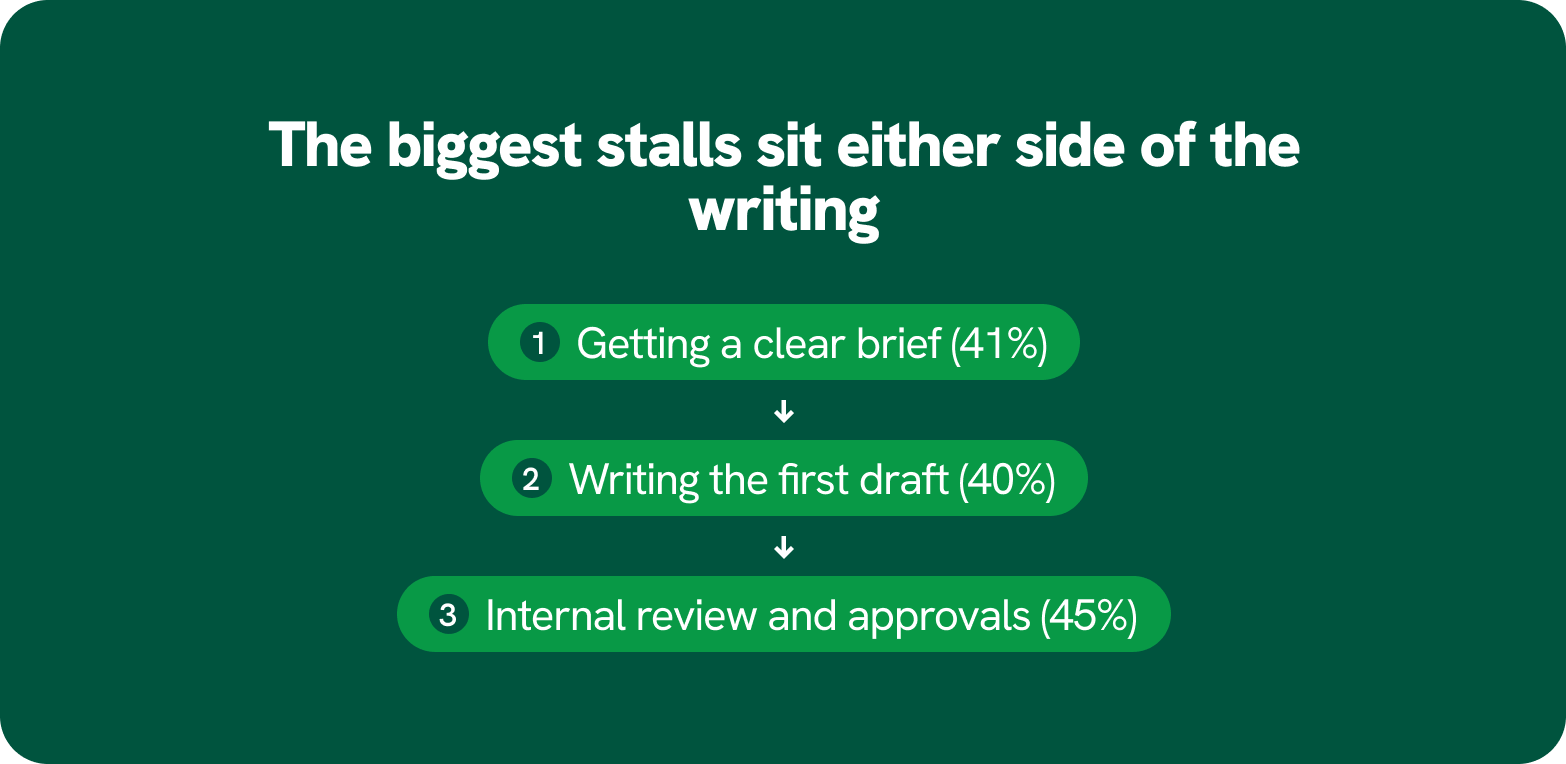
Look at where the work stalls and the picture sharpens. Internal review and approvals is the top-cited bottleneck, named by 45% of teams. Getting a clear brief comes second at 41%. The first draft, the part most people picture when they think about content production, comes third at 40%. Put together, the two biggest stalls sit on either side of the writing: one before it starts and one after it ends.
When a workflow creaks, the usual response is to add something: a new tool, another reviewer, an extra field in the brief template. Each addition looks like process improvement. Each one also adds a handoff, a notification, and another person to chase, which feeds straight back into the coordination load from that Thursday morning. A good workflow earns its keep by shrinking the work around production. Organising the same amount of coordination more neatly only tidies the problem.
That's also why one fix rarely covers every pain. A team buried in approvals needs a different change from a team whose freelancers keep missing the voice, or a team whose localisation runs three weeks behind. The examples below are organised by pain for that reason. If you'd like the stage-by-stage version first, our guide to building a robust content creation workflow walks through it in order.
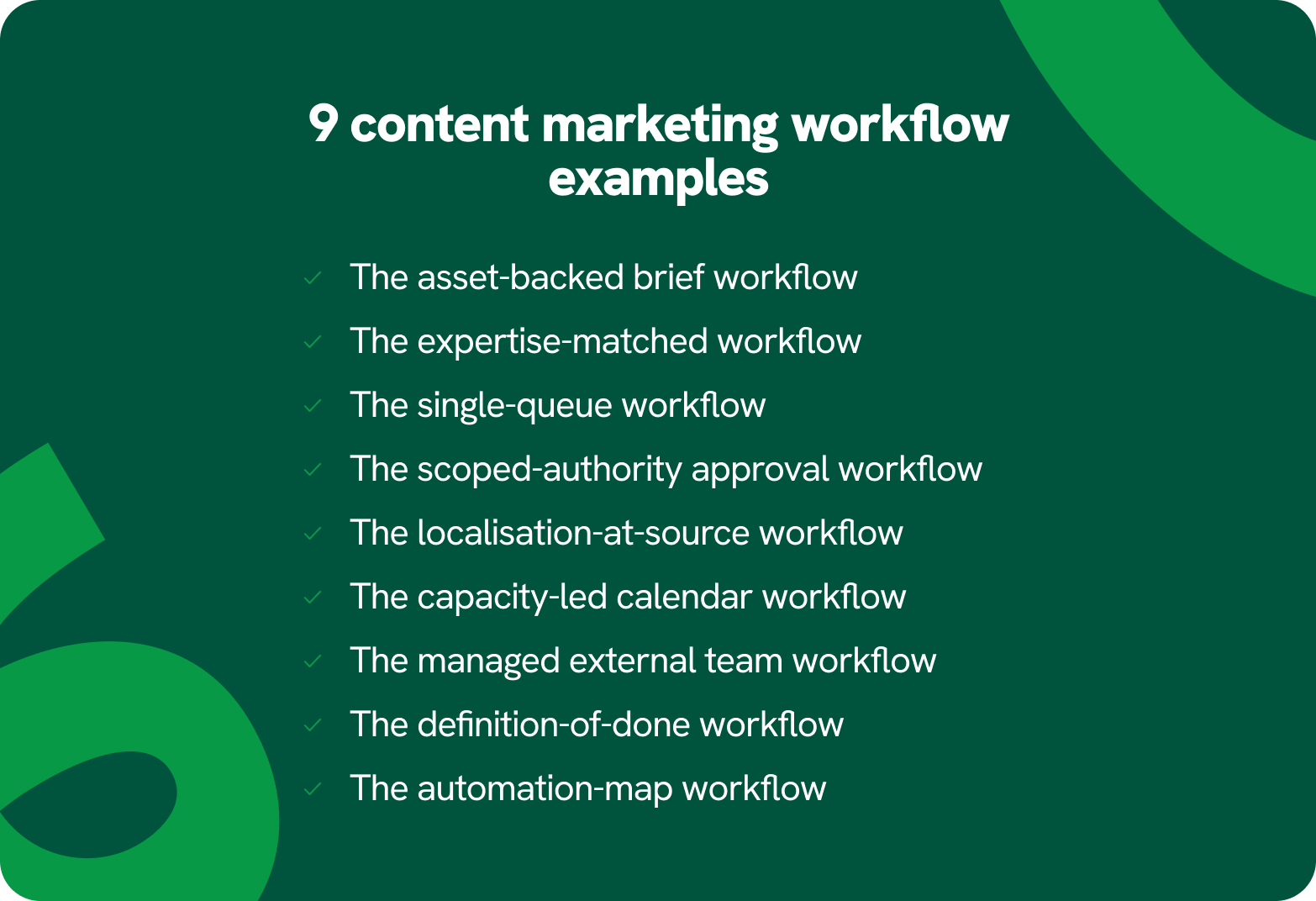
9 content marketing workflow examples, each built to remove a specific pain
Each example starts with a pain you'll probably recognise from your own week, names the structural reason it keeps coming back, and shows the workflow choice that removes it. The examples combine well. A team running content across several markets, stakeholders, and external contributors will usually find two or three that apply at once.
1. When drafts keep missing the mark: the asset-backed brief workflow
The pain. The first draft comes back competent, on topic, and wrong. The angle is off, the proof points are generic, and the tone belongs to somebody else's brand. So the draft goes round again, and then again.
Why it keeps happening. The context a writer needs lives in people's heads and old Slack threads. Each brief gets rebuilt from scratch by whoever has time, so its quality depends on who wrote it and how busy they were that day. In The Rant Report, poor or incomplete briefs were the top-cited quality killer, named by 56% of teams, which goes some way to explaining why getting a clear brief ranked as the second-biggest bottleneck earlier.
The workflow. The team builds every brief from a library of approved assets: core messaging, verified proof points, customer stories cleared for use, and past pieces that performed. The person briefing selects and sharpens instead of starting from a blank page. Brief sign-off then works as a gate, so writing starts only once the angle, audience, and proof are agreed. A brief written in a hurry still inherits the careful work that went into the assets behind it, which is how the team's memory travels into every piece.
2. When technical topics take three rounds: the expertise-matched workflow
The pain. Your product is technical, or your audience is. The writer is good, but they're learning the subject on your time, and your subject matter experts end up rewriting paragraphs at nine in the evening.
Why it keeps happening. Writers get assigned by availability: whoever has room this week takes the next piece. The expertise gap then surfaces in review, the most expensive place to find it, and the SME quietly becomes an unpaid co-author.
The workflow. The team routes topics to writers by domain expertise, so the person writing about payroll compliance has written about payroll compliance before. Where the depth sits with an internal expert, a short structured interview replaces the request to "jot down a few notes". The expert talks for 30 minutes, the writer turns that into a draft, and the expert reviews for accuracy alone. A sound process can't close the gap between an average writer and an excellent one on a hard topic, so the workflow's job is to put the right expertise on the piece from the first word. Matching costs a little planning up front and saves a round of rewrites on every piece after it.
3. When you spend more time chasing than producing: the single-queue workflow
The pain. You know roughly where everything is. The draft is with Tom, probably. Design said Friday. Legal hasn't replied. Answering "where's that piece?" takes three tools and a message to someone who turns out to be on holiday.
Why it keeps happening. Status lives in DMs, inboxes, and memory, and every handoff depends on someone remembering to make it. Nobody owns the queue end to end, so everyone owns a slice of the chasing. Bojana Vojnović, Head of Content at HeyReach, summed up the feeling in The Rant Report: "Everything is connected, but nothing's connected." This is the kind of work that fills the 40%-plus of the week we started with.
The workflow. One named person owns the production queue, and every piece sits in one place showing its current stage and whose move it is. Handoffs trigger on a status change: the writer marks a draft ready, and the reviewer sees it without a message in between. Whether your team tracks this as tasks (write, edit, approve) or as statuses (draft, in review, approved) matters less than having one owner for the whole line. Status meetings shrink because the status is already on the screen. The work that disappears here is the chasing itself, which is the clearest sign a workflow is doing its job.
4. When five people can stop a piece: the scoped-authority approval workflow
The pain. Feedback arrives from five directions. Product wants more features in it, sales wants a different customer story, the CMO wants a punchier headline, and the comments contradict each other. The piece sits until someone gives up.
Why it keeps happening. Review authority was never defined, so every comment carries the same weight as every other. Simone Engbo Hansen, Content & Communications Lead at Airtame, described where that ends up: "I tried having things sign off before going live. Someone had to sign off, then it had to go to the board, and the diluted version came through the manager three months later... That's where a content angel loses her wings."
The workflow. The team scopes review authority by domain and agrees it before production starts. The SME can block on technical accuracy. Legal can block on a compliance claim. The content lead decides everything else, headline included, and input outside someone's domain is welcome as advice. Reviews run in fixed windows, so a piece joins Thursday's slot instead of waiting for whoever opens it first. In regulated industries, this is the backbone of a healthcare content marketing workflow: clinical and legal reviewers keep their blocking authority, on their own domain, inside a predictable weekly slot.
Lean review also tends to move faster. Around 70% of teams in The Rant Report have two or three stakeholders in review, and only 7% of those teams take two weeks or more to publish. Everyone still gets a say. Fewer people hold a veto, and each veto has a clear edge.
5. When every new market reopens the process: the localisation-at-source workflow
The pain. The English version ships. Then each market turns into its own small project: translate, discover the keyword doesn't work locally, rewrite the intro, chase a reviewer in another time zone. Three weeks later the French version goes live, and the campaign it was meant to support has already ended.
Why it keeps happening. Localisation gets bolted on after the source content is final, so every market inherits decisions made for a different audience and has to undo them one by one.
The workflow. Market needs go into the source brief. Before anyone writes the English version, the brief names the target keyword and search intent in each market, the local competitors, and any claims that need adapting. A native writer or reviewer then checks cultural fit against that brief, and each market publishes on the same cadence as the source. tado° expanded its energy management content into more than seven markets with a lean internal team, working with Contentoo. For where AI fits into this stage, see why AI localisation only works when humans stay part of it. The cheapest place to localise is the brief, before there's anything to undo.
6. When output went up and quality quietly went down: the capacity-led calendar workflow
The pain. The calendar promised four pieces a week. The team can produce two at the standard you'd put your name to. Volume wins the argument every Monday, and quality slips a little each time, quietly enough that nobody calls it.
Why it keeps happening. Publishing velocity was set before anyone knew the team's real production capacity, and quality only gets defined at review, when it's too late to shape the work. In The Rant Report, pressure to hit volume targets was the second most-cited quality killer at 46%, and 80% of teams said they regularly publish content they know isn't good enough.
The workflow. The content lead builds the calendar from real capacity: how many pieces the team and its external contributors can produce at standard in a given month. The writer, editor, and stakeholders agree a short written definition of quality before production starts. As we've argued before, quality is in the eye of the stakeholder, which is exactly why it needs agreeing at the start.
Sometimes the honest answer is that the team needs more capacity. A capacity-led calendar makes that visible early, while there's still time to act on it, and turns the choice into an explicit one: add capacity, cut volume, or accept a different standard for a defined content type. If adding capacity is the answer, these content scaling tips cover how to grow output and keep the standard.
7. When every new freelancer means re-explaining the brand: the managed external team workflow
The pain. A new freelancer starts, so you run the onboarding call again: the voice guide, the product, the customers, the words you never use. Two pieces later they move on, and you start over with the next one.
Why it keeps happening. The context stays with the internal team, so every external contributor starts cold. Each new writer adds onboarding time, review time, and one more person to coordinate, which is the opposite of what you brought them in for.
The workflow. External writers work as a persistent team that keeps its context between pieces, with a dedicated editor who holds the voice, briefs the writers, and runs the first quality pass. The internal team works with one editorial point of contact instead of six individuals. Webs raised both production volume and content quality by working with Contentoo's managed writers and editorial workflow. If you run external writers yourself, the five most common mistakes with content freelancers and our guide to onboarding external content creators cover the groundwork. Continuity is what turns a rotating cast of writers into an extension of the team.
8. When drafts sit at "nearly done" for weeks: the definition-of-done workflow
The pain. The piece is written and approved, and it still hasn't gone live. It needs images, a CMS entry, an SEO check, internal links, and a final read from someone who's away. Every task is small, and none of them has an owner.
Why it keeps happening. "Done" means "written", so the final mile belongs to nobody. Distribution gets the same treatment: the social posts and the newsletter cut are planned for "after launch", which often means they never happen. That gap matters, since better distribution was the top ask in The Rant Report, named by 52% of teams.
The workflow. The team writes an explicit definition of done for every content type: published, visuals placed, metadata set, internal links added, and derivative assets scheduled. A named publish owner moves each piece across that line, and the final-mile tasks sit in the same queue as the writing, with dates attached. Repurposing becomes part of the plan from the brief onwards. The brief names the social posts, email section, and short-form cuts the pillar piece will feed, so the writer structures it for extraction from the start. A piece counts as finished when a reader can find it.
9. When AI sped up drafting but review got heavier: the automation-map workflow
The pain. AI made first drafts faster, and somehow the team is busier. Every draft needs a heavier edit, nobody's sure what was checked, and confidence in the output hasn't moved.
Why it keeps happening. AI got added to individual tasks before anyone decided where human judgement sits. Sara Stella Lattanzio, B2B Marketing Advisor, put the underlying problem plainly: "The strategic problems that didn't make content work in the first place are completely the same."
The workflow. Map each stage of the workflow and decide, explicitly, what gets automated, what gets AI assistance, and where a person owns the decision. Objective checks such as formatting, metadata, banned phrases, and link validation go to automation, so people spend their time on judgement calls: angle, accuracy, voice, and whether the piece deserves publishing at all. Teams in The Rant Report already lean this way. Content briefs were the top AI use case at 46%, while only 21% used AI for drafting.
The way teams adopt AI seems to matter too. Around 51–54% of teams that fundamentally restructured their workflow around AI said they were very confident in their content quality, compared with around 34% of teams that used AI to go faster within the same workflow. That suggests AI helps most when the workflow around it has been redesigned for it. Automate the checks, and keep the judgement with people.
What changes when the work around content shrinks
Put the nine examples side by side and they share one habit: each takes work out from around production. The asset-backed brief removes re-briefing. Scoped authority removes contradictory review rounds. The single queue removes the chasing, and localisation at source removes rework in every market. None of them adds a step for its own sake.
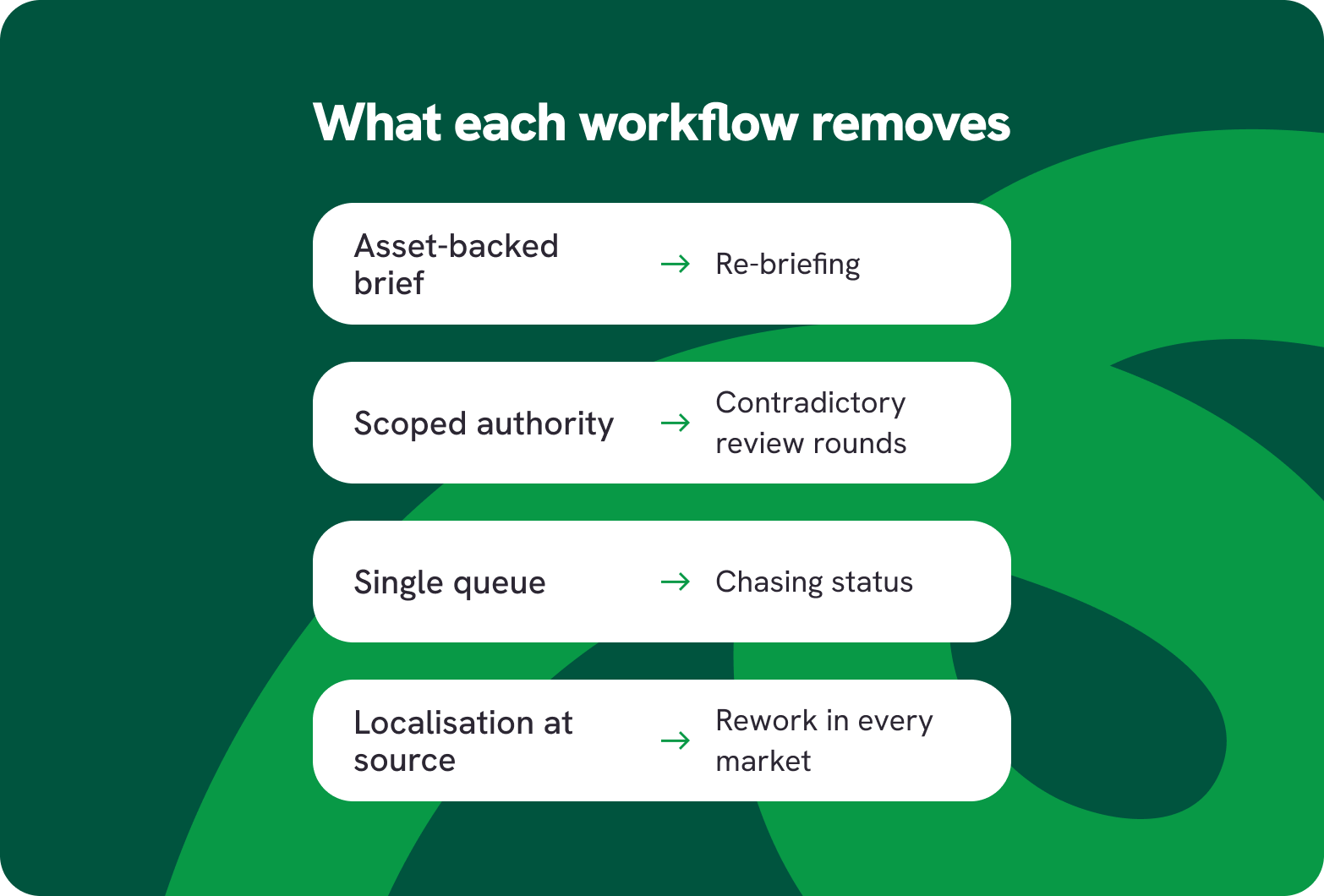
That's the test worth applying to any change to your content marketing workflow, a new tool included. Does it take coordination out, or does it move the same coordination somewhere else? Meister is a useful benchmark here: it achieved 10x more content production while spending 50% less time managing content.
Content leaders already sense where the gains are. In The Rant Report, 48% said they want better workflows and processes, while only 13% asked for more headcount and 7% for more budget. Tools still matter. Workflow software that shows every piece, its stage, and its owner in one view adds real value at higher volumes and across markets. It works best on top of the structural choices above, the way a good knife helps a cook who already knows the recipe.
Find the pain that's costing you the most
Start with where your week goes, then go to the example built for that pain.
| Where your week goes | Start with |
|---|---|
| Drafts come back off-angle or off-voice | 1, the asset-backed brief |
| Technical pieces need expert rewrites | 2, the expertise-matched workflow |
| You spend your days chasing status | 3, the single queue |
| Approvals stall or contradict each other | 4, scoped authority |
| New markets lag weeks behind the source | 5, localisation at source |
| Quality slips as volume rises | 6, the capacity-led calendar |
| Every new writer needs onboarding again | 7, the managed external team |
| Finished drafts take weeks to go live | 8, the definition of done |
| AI made you faster without making you more confident | 9, the automation map |
Then ask the visibility question. Can you see, right now, where every piece sits and whose move it is? If the honest answer involves three tools and a message to a colleague, start with example 3, because every other fix is easier to run once the work is visible.
Fix the work around the writing
Writing is the part of content production everyone pictures, and it's rarely the part that breaks. The pieces that stall, slip, or never ship usually got stuck in a handoff, a review, or a market nobody planned for. Shrink the work around the writing, and the writing finally gets room to be good.
If the work around your content is eating your week, that's the part Contentoo runs. As a managed operation with a vetted expert team, Contentoo takes on briefing, expert matching, coordination, review, and localisation inside one structured workflow, so your team spends its time on the decisions only it can make. See how Contentoo manages content complexity or book a demo.
FAQs
What is a content marketing workflow?
A content marketing workflow is the sequence of stages, owners, and decisions that takes a piece from idea to published and distributed. A content calendar tracks what's being made and when, and a content strategy decides why. The workflow is the operational layer between them, and it covers the work around the writing as well as the writing itself: briefing, matching expertise, review, localisation, and publishing.
What does a good content marketing workflow template include?
A good content marketing workflow template includes the stages, a named owner for each stage, what each reviewer has authority over, the review windows, and a definition of done for each content type. It should also show where external writers, localisation, and AI fit, because those are the points where work most often stalls. A template that lists stages without owners describes the ideal and leaves the coordination to chance.
What content marketing workflow software should I use?
The right content marketing workflow software is the one that makes your biggest bottleneck visible. Simple tools such as Google Docs, Notion, or Asana can run a sound workflow for a single team. Software that brings briefing, production status, approvals, and publishing into one view adds the most value at higher volumes, across several markets, or with many external contributors. Any software works best once ownership and approval authority are already defined.
How do you build a content marketing workflow for a small team?
A small team of two or three people should start with a reusable library of briefs and approved assets, a calendar set by real capacity, and a single reviewer per piece. With few handoffs, a small team usually needs a lighter workflow, so the priority is keeping briefs and the quality definition consistent when one person covers several roles. Investment in workflow pays back faster as markets, stakeholders, and external contributors are added.
How is a content marketing workflow different for healthcare?
A healthcare content marketing workflow follows the same core stages but adds clinical accuracy review and legal or compliance review with genuine blocking authority. A frequent failure is routing each article to those reviewers ad hoc, so pieces stall in an unpredictable queue. Scheduling fixed weekly review slots, and scoping each reviewer's authority to their own domain, keeps compliance rigorous and the publishing schedule predictable.
What's the biggest mistake teams make with content marketing workflows?
The biggest mistake is treating every workflow problem as the same problem and fixing it by adding steps. A team stuck in approvals needs clearer decision ownership, a team losing time to freelancer onboarding needs continuity and fewer handoffs, and a team scaling across markets needs localisation built into the brief. Adding a tool or a reviewer without diagnosing the pain usually adds coordination, which is already where many content leaders lose 40% or more of their week.
What are the best practices for content marketing workflow efficiency in 2026?
The best practices for content marketing workflow efficiency in 2026 start with diagnosing where work stalls before changing anything. From there, the practices that tend to pay off are briefs built from approved assets, domain-scoped approval authority, one owner for the production queue, localisation planned at source, a calendar set by real capacity, and an explicit decision on where AI assists and where people judge. Every practice can be measured by one test: whether it reduces the work around producing content.







.webp)