A year in content marketing: what actually changed (and what we’re taking into 2026)


December has a strange energy.
Half the industry is already mentally offline. The other half is frantically planning next year, pretending everything will be “different” come January. Somewhere in between sits the reality: this year moved fast, left a few bruises, and very much reshaped how content marketing teams will work in 2026.
As content marketing trends for 2026 start to take shape, this year has already given us some clear signals.
Alas, fear not, this isn’t yet another trend report. It’s a look back at what went on, what needs to stick around.
Let’s get into it.
The year we stopped pretending AI was optional
If this year had a headline, it would be something like: “You can’t ignore this anymore.”
AI went from curiosity to a conversation starter to an operational question almost overnight.
Our research found that 86% of content teams already use AI in their workflows, with 35% saying it’s embedded in real processes, not just for experimentation.
Not because the tools were perfect (they weren’t), but because the pressure on teams made experimentation unavoidable.
The most valuable conversations weren’t about tools. They were about boundaries.
AI is indispensable—for research, editing, prep. But not for writing. It’s my co-pilot, not my pilot. — Kimberley Collins, SVP of Strategy and Product at #samsales
- What can be automated without losing quality?
- Where does human judgment still matter most?
- And what breaks when speed becomes the only metric?
By the end of the year, the teams doing this well weren’t chasing every update. They were building guardrails.
Read all about it: The future of content marketing: humans + AI
“Do more with less” stopped being motivational
For a while, “do more with less” sounded aspirational. This year, it became the baseline.
38% of respondents feel stretched or completely overloaded
40%+ say this happens often or constantly
The most common team size response was “just me”
Smaller teams. Tighter budgets. Higher expectations. Content teams were asked to scale output while also improving consistency, localisation, and performance.
The response wasn’t more hustle. It was about more structure when it comes to content workflows.
You can only go so fast when you’re three people doing ten people’s jobs. AI helps. Freelancers help. But the biggest challenge is prioritisation—because the ask is always: ‘Can we do more?’ — Briana Palma, Marketing Director at We Are Rosie
Content processes mattered. Content workflows mattered. Clear ownership mattered. Teams started caring less about how much they shipped and more about whether they could sustain it.
Content operations very quickly became the main character. Finally.
34% describe their content stack as “scrappy, but it gets the job done”
37 respondents cited revisions and approvals as a major bottleneck
Some teams involve up to 22 people to sign off on a single piece of content.
AI handles the monkey work—so we can focus on thinking. It’s not about saving time, it’s about saving headspace. —Manoosh Majdzadeh, Head of Marketing at exalate
Read: 50 statistics every marketer should know in 2026
Content grew up
This year made one thing very clear: content isn’t a side project anymore.
38% of companies don’t even have a dedicated content team, yet content is expected to support brand, demand gen, product education, and customer success.
It touches:
- Product education
- Sales enablement
- Brand trust
- Search visibility (in places that don’t look like Google)
Which means content quality, governance, and consistency stopped being nice-to-haves. They became risk management.
Content doesn’t scale if you’re just feeding the beast. It scales if it creates leverage—across sales, onboarding, and product. — Vukasin Vukosavljevic, CMO at HeyReach
Curious about AI visibility? Join the beta and see how you rank.
What didn’t survive the year
Some ideas didn’t make it.
- One-off campaigns with no follow-through
- Content produced without a clear owner
- Scaling output without thinking about review, maintenance, or localisation
They worked briefly. Then they became invisible. This year was unforgiving in that way.
92% of teams report challenges with freelancers or agencies, primarily due to inconsistent content quality, onboarding friction, and lack of alignment
Finding the right freelancers who are fully up to speed on our brand voice and strategy—and that we can rely on consistently—that’s the real challenge. — Amy Watts, Marketing Communications Manager
A subtle shift: community over broadcast
Amid all the noise, something softer happened.
Smaller events. More conversations. Less performance. People showed up not for hot takes, but for shared context.
As the volume of AI slop increases, I think we’ll see an even bigger appetite for authentic content that has a real human point of view. — Survey respondent, State of Content Teams 2025
Real stories. Honest “we’re figuring this out too” moments. Marketing felt less like shouting into the void and more like sitting at the same table again.
A welcome change.
So what do these content marketing trends mean for 2026?
What we’re taking into 2026
If this year taught us anything, it’s that complexity doesn’t equal sophistication.
The teams that looked calm weren’t doing more. They were doing fewer things with more intention. These aren’t predictions or hot takes, they’re the content marketing trends for 2026 that actually showed up in real teams.
Clear goals, solid content workflows and even better, clear decisions about what not to do. That’s what holds when things speed up.
Download: Content Quality Checklist
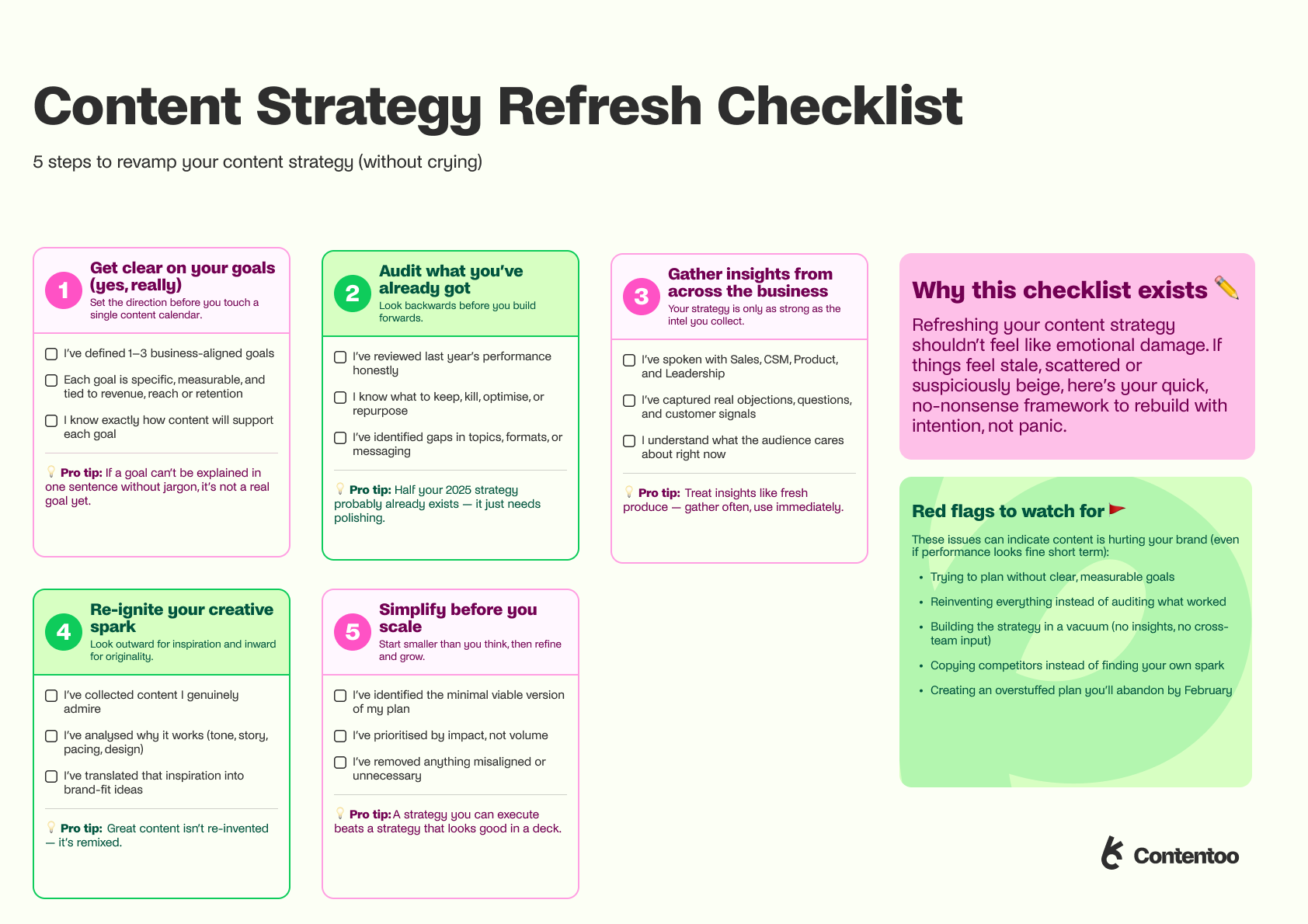
Planning content marketing strategy in 2026? Start here
If you’re heading into planning mode, resist the urge to start from scratch.
Instead, ask:
- What’s actually working?
- Where are the bottlenecks?
- And what would break if volume doubled tomorrow?
We put together a short checklist to help teams do precisely that, a practical way to pressure-test your content strategy before locking anything in. It’s not a silver bullet, but it’s a solid place to start.
Download: Revamp your content strategy: a 5-step checklist
One last thing
Next year will bring new tools, new tactics, and new opinions. That’s a given.
What matters is whether your content system can absorb change without collapsing under it.
Build for clarity, and the rest will follow.

.webp)
.webp)